
Andrew Wilson Went 0-for-7 and Claimed Victory
DEBATE CLUB
HE WENT 0-FOR-7
AND CLAIMED VICTORY
How Candace Owens vs. Andrew Wilson became a credibility event — and why massive exposure did not automatically become a win.
AUDIENCE REACTION • DEBATE ANALYSIS • BRAND CONSEQUENCES
Andrew may genuinely believe he won, and he had strong moments. But for much of the audience, the debate was reduced to one exchange: 0-for-7 on the official charges against Tyler Robinson. The miss was damaging enough. The optics made it worse.
THE OPENING
The Moment the Debate Became 0-for-7
Andrew said he knew the charges. Candace asked him to name one.
Wilson pressured Owens, interrupted her, held up his hand and counted as she answered, appearing to expect her to stumble. Instead, Owens stayed calm and named all seven charges in order. Wilson then suggested someone might have texted her the answer. She handed her phone to the moderator, and no such communication was found.
Simply saying Andrew did not know the seven charges understates what viewers actually watched.
Public events are often remembered this way.
On October 21, 1984, Ronald Reagan was asked whether age had diminished his ability to serve. He answered: “I will not make age an issue of this campaign. I am not going to exploit, for political purposes, my opponent’s youth and inexperience.” The room erupted in laughter and applause. A question aimed directly at Reagan’s greatest vulnerability instead produced the enduring moment of his debate with Walter Mondale.
On June 15, 1995, after months of testimony in the O.J. Simpson murder trial, prosecutors had Simpson try on the bloody gloves they said connected him to the killings. They appeared too small. Simpson turned toward the jury and said, “Too tight.” The demonstration immediately became one of the defining images of the trial. Months later, Johnnie Cochran compressed that image into the closing refrain: “If it doesn’t fit, you must acquit.” Whatever the rest of the evidence, the glove demonstration survived because everyone could understand it instantly.
And on October 5, 1988, Dan Quayle defended his readiness for the vice presidency by comparing his congressional experience to John F. Kennedy’s before Kennedy sought the presidency. Lloyd Bentsen answered with the line that swallowed almost everything else from the debate:
“Senator, I served with Jack Kennedy, I knew Jack Kennedy, Jack Kennedy was a friend of mine. Senator, you are no Jack Kennedy.”
The audience exploded. More than three decades later, that remains the exchange most associated with the debate.
On January 19, 2004, after finishing third in the Iowa caucuses, Howard Dean tried to rally supporters by rattling off the states his campaign would fight through next before ending with a cracked, full-volume “YEAH!” Television microphones isolated his voice from the crowd noise, and the clip was replayed relentlessly. Dean had not lost the nomination because of one yell alone, but the scream became the image that swallowed the larger campaign. Years later, people who remember almost nothing else about his candidacy still remember that sound.
In March 2008, CNBC’s Jim Cramer was asked whether a viewer should worry about Bear Stearns. Cramer answered with the confidence of someone whose entire public brand was built on reading markets: “Bear Stearns is fine.” He told the viewer not to pull his money. Within days, Bear Stearns collapsed into an emergency Federal Reserve-backed sale to JPMorgan Chase. The clip survived because it was not simply a bad prediction. It was certainty, delivered by a market expert, immediately overtaken by reality.
That is the problem with declaring yourself the king of debaters: the standard rises with the reputation. Modern audiences consume politics the way they consume sports—through the one-handed catch, the knockout, the poster dunk, the moment that survives after everything around it fades.
Fair or not, Wilson lost that highlight battle badly. He did not merely go 0-for-7. He challenged Owens on the very ground where he was supposed to hold the advantage, tried to maintain control as the exchange turned against him, and then watched her calmly finish the sequence.
Candace posterized Andrew in the defining highlight of the debate.
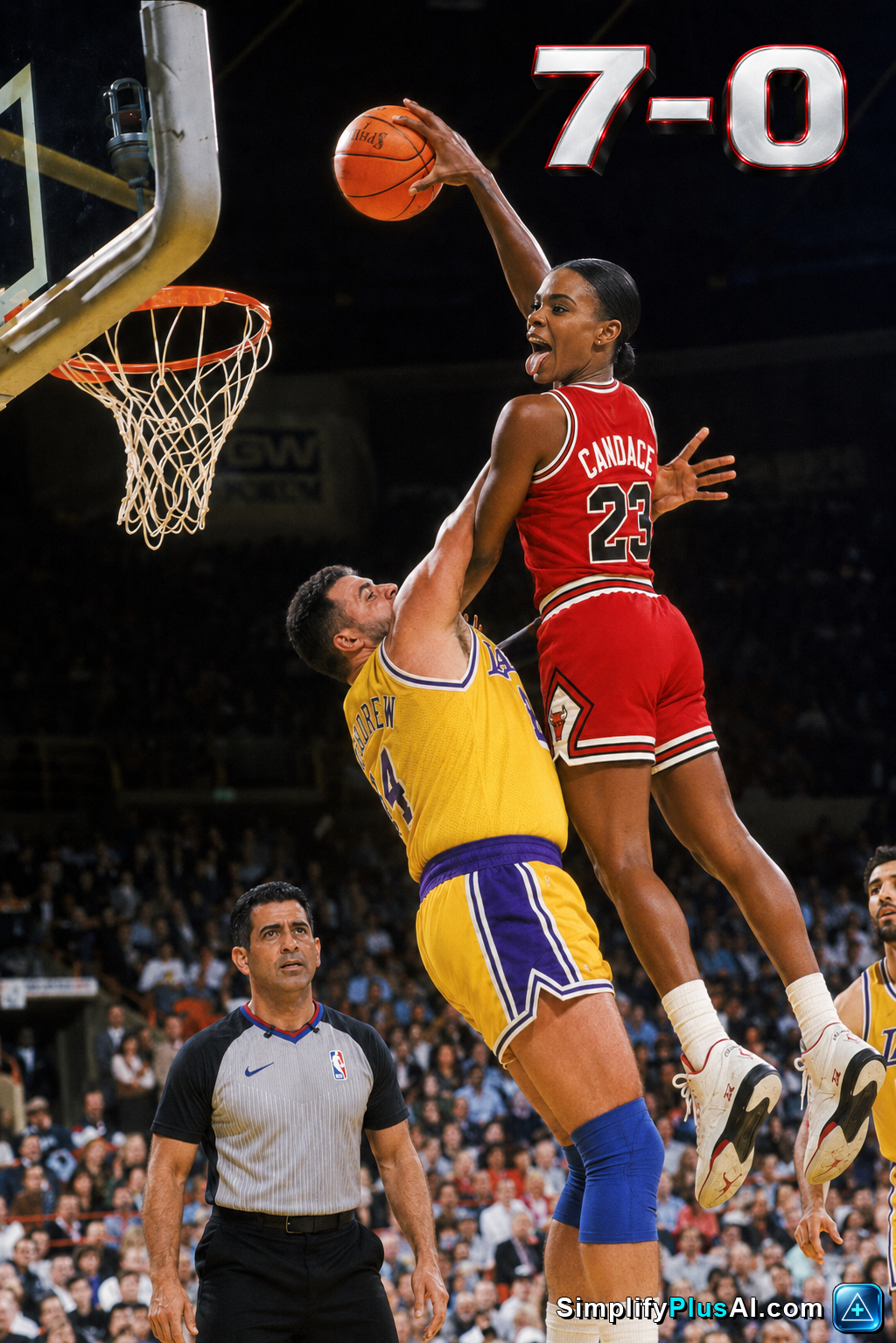
That does not settle the underlying Tyler Robinson case. It does not prove every broader claim Owens has made. A debate-performance failure and the factual truth of the underlying case remain separate questions.
But public memory is rarely built from three hours of argument. It is built from the moment people can replay in a few seconds to a few minutes.
And when this debate is discussed months or years from now, 0-for-7 is likely to be the clip people replay. That moment will not age well for Wilson. For Owens, it did the opposite. She entered the debate with an established audience and a podcast that had already reached the top of major charts. The exchange gave her another highly portable moment that reinforced the image her supporters already had of her: prepared, composed and willing to challenge the official case.
Her own comment section showed no meaningful sign that the debate damaged her standing with that audience. The reaction ran strongly in her favor. That does not prove the exchange increased her overall audience, podcast ranking or long-term brand value; those claims would require separate before-and-after growth data.
What it does show is narrower and more defensible: the most replayable factual exchange of the night belonged to Candace Owens, and her existing audience treated it as a victory rather than a liability.
CREDIBILITY
Why Seven Charges Became the Scoreboard
The audience did not treat the exchange as a trivia miss.
The strongest defense of Andrew is straightforward: memorizing a charging document does not prove Candace’s larger theory. Dave Smith made that distinction. Valuetainment’s panel did too. A person can know every charge and still be wrong about the underlying case.
But the crowd was reacting to the sequence, not merely the fact that Andrew could not recite a document from memory. He indicated that he knew the charges, failed to identify them, then shifted into procedural pressure while Candace produced the list. The public read the exchange as a credibility reversal.
Robbie Bernstein pushed the criticism further. Watching Andrew maneuver after the miss, Robbie said the exchange looked less like an honest pursuit of truth and more like “a display of tactics.” His normal advantage is procedural control. Here, the same skill set looked to many viewers like an attempt to move away from a factual hole.
The internet then compressed the argument into something portable. Ballistics, hearsay rules, source credibility and motive theories require explanation. A 7–0 scoreboard does not.
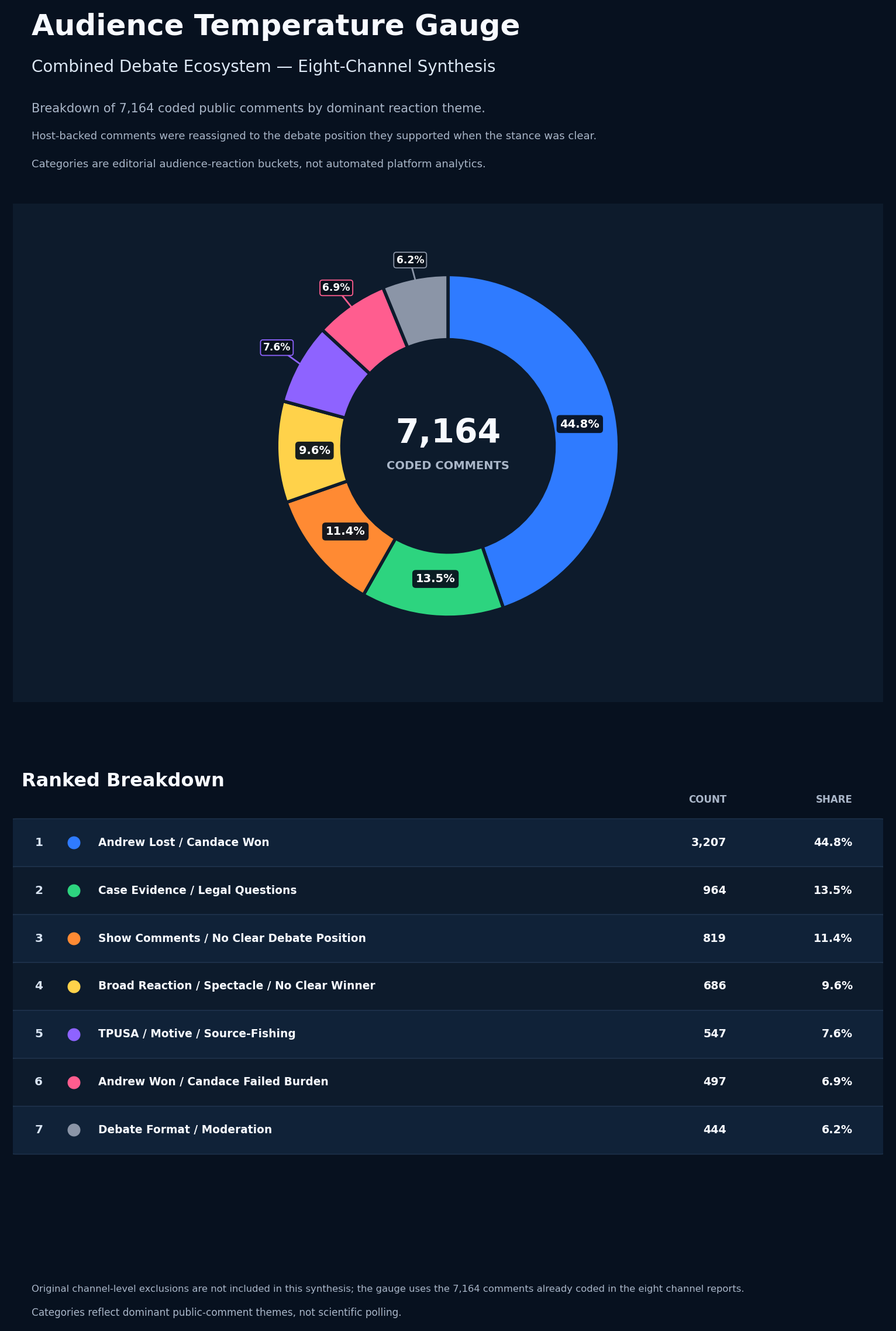
Combined eight-channel audience synthesis — 7,164 coded comments.
THE CROWD'S VERDICT
151,724 Votes. Candace Won 69–31.
PBD Podcast asked the simplest question possible: Who won?
The strongest mass-audience signal in the reaction set came from the media organization that hosted the debate. PBD Podcast asked its X audience one question: “Who won?” The final result drew 151,724 votes. Candace Owens received 69 percent. Andrew Wilson received 31 percent.
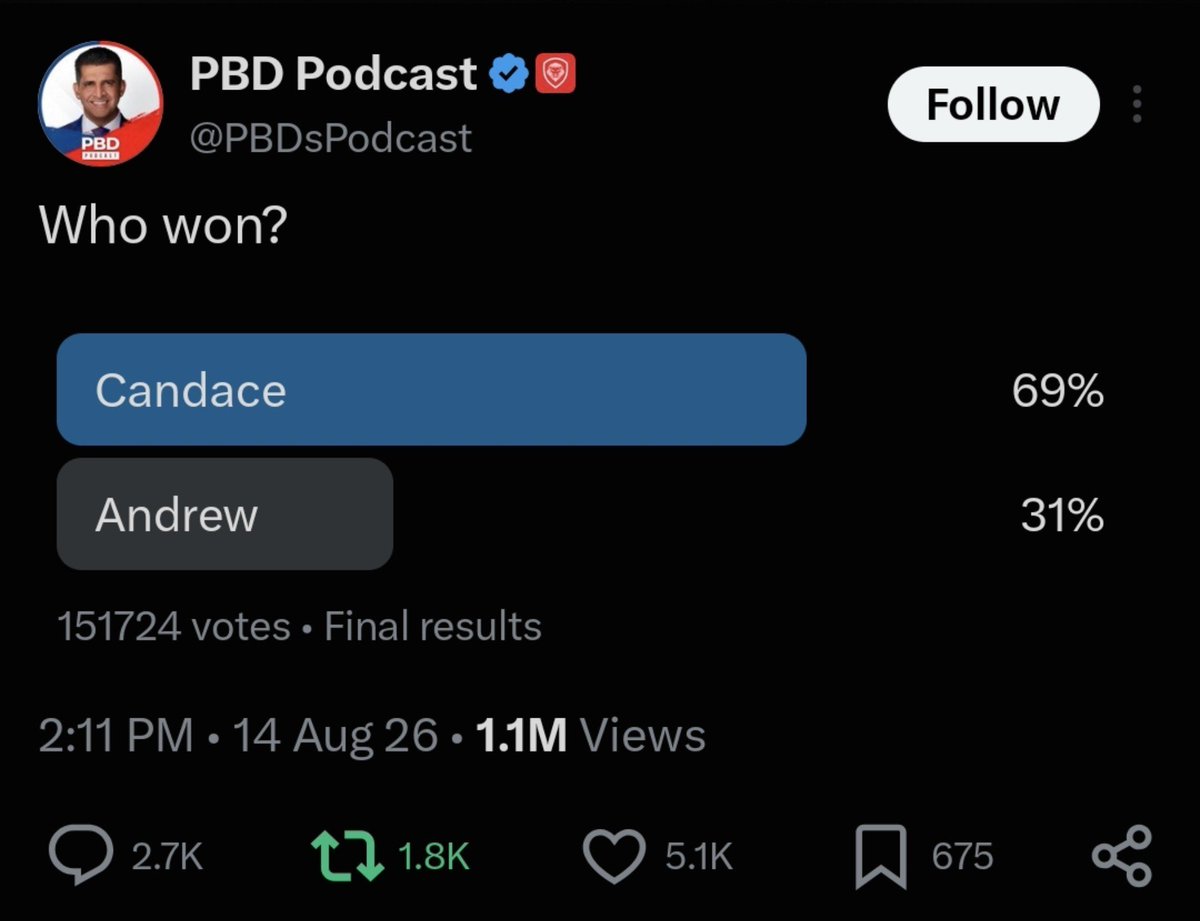
PBD Podcast final X poll: 151,724 votes — Candace 69%, Andrew 31%.
That is a 38-point margin. More than two-thirds of voters chose Candace; fewer than one-third chose Andrew. The result works out to roughly 2.2 votes for Candace for every one vote for Andrew. An open X poll is not a scientific survey and reflects the audience that saw and chose to answer it. But at this scale, on the host platform’s own account, it is difficult to dismiss as a handful of partisan commenters.
REACTION ROOMS
The Criticism Did Not Come From One Tribe
The harshest reactions came from audiences with different reasons to disagree.
Dave Smith and Robbie Bernstein: tactics versus truth
Robbie’s criticism went beyond individual exchanges. From what he had seen, Andrew’s style looked “less of a pursuit of finding truth” and more like the sportsmanship of debating. He called Andrew the “big loser” because a man who demands tightly reasoned positions walked in claiming overwhelming evidence and never established the case with the force his certainty implied.
Dave was more charitable to Andrew as a debater, but he still rejected the idea that audience response could be waved away as mere popularity. His rule was simple: if 70 percent of the audience thinks the other person won, “I lose then.” He added, “You got to win over the audience. That’s the whole job of this thing.”
Dave’s own comment section leaned toward Robbie’s harsher interpretation. The most rewarded reactions praised Robbie for “keeping it 100% real” and criticized Dave for softening Andrew’s loss.
Destiny: no need to believe Candace to think Andrew failed
Destiny was brutal toward Candace’s credibility, saying he believed she knowingly lied. Yet during the debate he also said Andrew “dramatically overestimates his appeal or charm,” had not made his case, and came across as “salty and weak rather than domineering.”
When the charges sequence arrived, Destiny immediately recognized the problem: “Oh, he doesn’t even know, dude.” That came from someone who was simultaneously attacking Candace. Disliking Owens did not require him to rescue Wilson.
Liberty Lockdown: gifted debater, poor preparation
Clint Russell entered with respect for Andrew’s debating ability. He left saying Andrew had “sat his credibility at the door,” had not researched the case enough, and had paid for what Clint called a “public flogging.”
Clint still gave Andrew his due as a pure tactician. He called him the more gifted debater and acknowledged that the closing argument — Candace had not proved her broader claims — could be compelling. Debate technique and case preparation are not the same skill.
Heavy Duty Country: the reaction becomes social
Heavy Duty Country moved beyond debate mechanics into reputation. One host said Andrew had “no principles.” The criticism escalated from there: “I would be embarrassed to go into Dallas and go get dinner with him if I knew him,” followed by, “I would not want to be seen anywhere with that guy.” The other speaker agreed.
The same discussion attacked Andrew’s macho presentation as a character he was trying to play and described his communication style as listening for the next opportunity to be snarky and make the other person look bad.
REAL-TIME PUBLIC SIGNAL
The Betting Market Moved During the Debate
The market for a Tyler Robinson homicide conviction moved sharply downward while the event was unfolding.
The public reaction was not confined to comments and clips. A Polymarket market asking whether Tyler Robinson would be convicted of homicide also moved sharply during the debate. The supplied snapshot shows the price near 39 percent before the first major decline, dropping into the mid-35 percent range during the event, dipping again near the debate’s conclusion, and then partially recovering to roughly 35 percent.
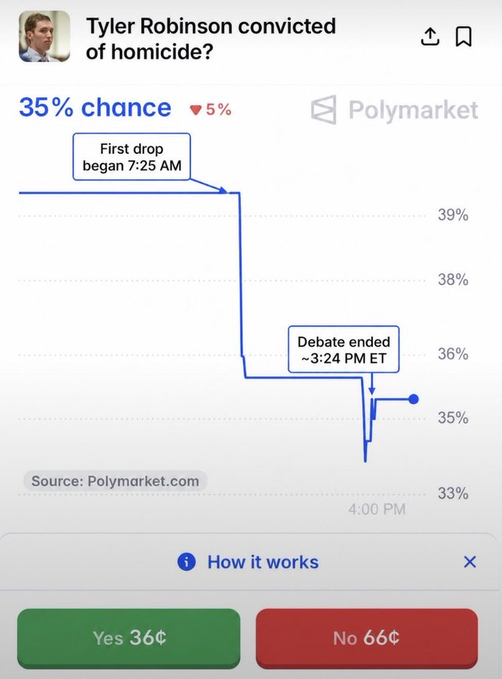
Polymarket snapshot supplied with the debate timeline: the market fell several points during the event, briefly dipped again near the debate’s end, then partially recovered.
The timing points directly at the debate. The defense filing drawing major case coverage had already been public before the event; prosecutors were not due to answer until August 18, and the next court hearing was scheduled for September 1. No comparable case development was identified during the debate window. Against that timeline, the debate itself is the clearest contemporaneous catalyst for the intraday move: while Wilson was arguing that the evidence against Robinson was overwhelming, traders pushed the market toward a lower probability of conviction. The price later recovered, but the immediate direction was against the position Wilson was defending.
THE COUNTERCASE
The Strongest Case Against Candace
Andrew’s collapse did not turn every Owens claim into a proven fact.
The strongest criticism of Candace is not that Andrew looked better. It is that exposing weaknesses in Andrew’s argument does not automatically prove every alternative theory she has advanced. Valuetainment’s panel stated the problem clearly: finding holes in the government’s case does not, by itself, establish the replacement theory.
The best dissent across the eight audience rooms kept returning to that distinction. Commenters argued that Candace relied on inference, secondhand claims and speculation in places; that the seven-charges embarrassment did not settle the formal proposition; and that reasonable doubt is not the same thing as proof of a broader setup.
Destiny’s criticism of Candace was even harsher. He said he believed she knowingly lied. That accusation is his judgment, not an established fact, but it shows why criticism of Andrew cannot be treated as automatic endorsement of Owens.
The clean conclusion is narrower. Candace created doubt, exposed preparation gaps and controlled the public memory of the event. Whether she proved every larger claim is a separate evidentiary question.
| Audience | Strongest pro-Andrew point | What it preserves |
|---|---|---|
| Andrew / The Crucible | Candace’s own reliance on secondhand claims complicates her hearsay criticism. | An evidence-standard objection. |
| Valuetainment | Knowing the seven charges did not settle the formal proposition. | A separation between optics and proof. |
| Dave Smith audience | Candace evaded questions and relied on inference in places. | A burden-of-proof challenge. |
| Heavy Duty Country dissent | Some viewers still thought Candace failed to answer key questions. | Meaningful dissent inside an anti-Andrew room. |
PUBLIC MEMORY
When $300,000, a Foot, and a Pickle Jar Became the Debate
Humor became a form of status judgment.
The most damaging post-debate development for Andrew was not another technical rebuttal. It was compression. The internet converted a four-hour event into a handful of portable objects and phrases: seven charges, 75–85 percent, the shaking foot, “show the text,” the $300,000 payment and the pickle jar.
The money mattered because Andrew supplied the stakes himself. Before the debate, the extraordinary payment signaled confidence and spectacle. Afterward, reactors inverted it. Heavy Duty Country asked why anyone would pay that much merely to repeat prosecution material people already knew and joked that Andrew should have bought a boat. Clint Russell described the event as paying for a public flogging.
Then came Pickles. The joke had almost nothing to do with the criminal case, which is precisely why it traveled so well. “Candace sat there for 4 hours just opening pickle jars in Andrew’s face” earned 1.1K likes in the Liberty Lockdown sample. Another viewer joked that Andrew might still be trying to open a jar somewhere.
The same process hit the shaking foot. A visual tic became “Footloose,” then a fan, then a reusable shorthand for nerves and loss. Whether the movement actually proved nervousness is beside the cultural point. Viewers did not need a clinical explanation to turn the image into folklore.
THE HOME ROOM
Andrew’s Audience Rallied — But the Exposure Still Had to Convert
The later Crucible capture became much more competitive.
Andrew’s Crucible audience was sharply divided. Among 908 coded comments, 387 — 42.6% — fell into Andrew Lost / Credibility Collapse, while 365 — 40.2% — fell into Andrew Defense / Candace Had No Evidence.
That is essentially a split home audience. Even on Andrew’s own channel, the negative verdict slightly outnumbered the defense of his performance.

Later Crucible snapshot — 42.6% Andrew lost / credibility collapse, 40.2% Andrew defense.
The two snapshots are not a controlled before-and-after panel. They are captures of a live comment section at different moments. What they show is a home-audience rally, not a clean disappearance of the original backlash.
Exposure is not conversion
The larger business question is what all that attention actually bought. Andrew undeniably received an extraordinary burst of exposure. But the channel-growth snapshot around the debate shows a surprisingly modest subscriber result.
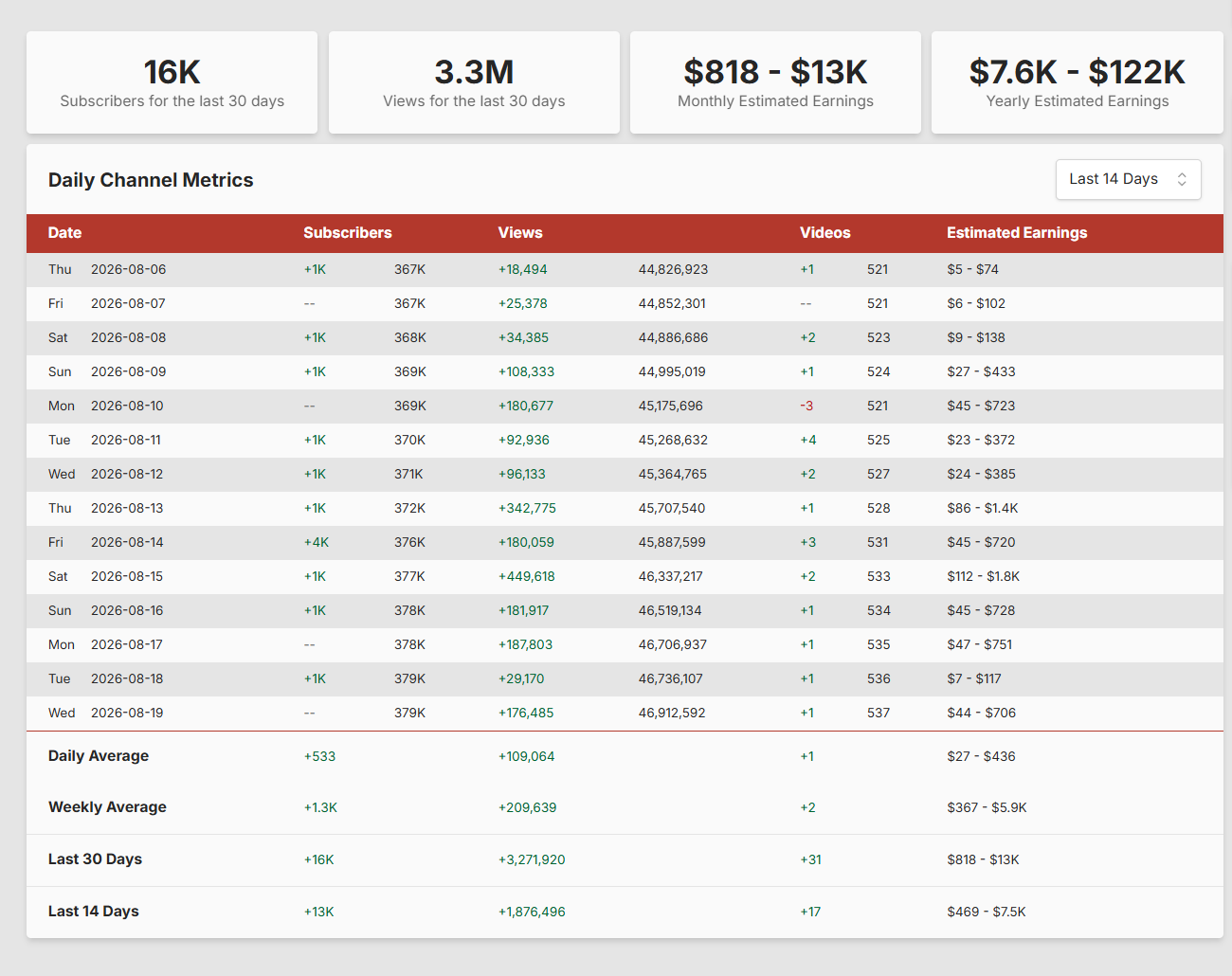
Social Blade snapshot around the debate: The Crucible gained about 4,000 subscribers on Friday, August 14, then immediately returned to roughly 1,000 or fewer new subscribers per day.
The displayed 30-day average was about 533 new subscribers per day. On Friday, August 14 — the largest subscriber day in the visible two-week window — The Crucible gained about 4,000. That is roughly 3,467 above the displayed daily average.
Against a $300,000 payment, that works out to approximately $86.55 per subscriber above the 30-day daily average. Use a more generous 1,000-subscriber normal-day baseline and the estimated incremental gain falls to about 3,000, or roughly $100 per extra subscriber.
THE PBD CLAIM
“Both Won” Works Better as Brand Management Than Debate Scoring
Reach, money and exposure are not interchangeable with victory.
Patrick Bet-David’s day-after framing turned the result into business language. PBD said he thought both participants won. For Candace, he cited the money, the chance to present her case, the willingness to concede a point and the ability to reach people who do not normally watch her.
Those are legitimate forms of value. They are not the same thing as winning the debate. PBD Podcast’s own final poll makes that distinction unusually clear: 151,724 voters were asked who won, and 69 percent chose Candace. The audience did not split the result. It delivered a 38-point margin.
If the debate functioned as a $300,000 audience-acquisition event, the subscriber result was weak. The biggest day in the visible tracking window added roughly 4,000 subscribers, against a normal pace of about 1,000 or less. Using that generous baseline, the debate appears to have produced about 3,000 incremental subscribers — roughly $100 each. The spike then faded immediately.
A Valuetainment commenter summarized the conversion problem in one line: “Overnight we all knew who Andrew Wilson is but we won’t be back for more.” The X poll supplied the performance verdict; the subscriber data supplied the business aftermath. Recognition rose. The evidence that affinity rose with it is much thinner.
The $300,000 bought more than subscribers. The debate generated publicity, clips, search interest and future recognition. But the available channel numbers do not support calling the spend a clear direct-growth win. On the most visible metric attached to a creator’s owned audience, conversion was thin relative to the size of the investment and the size of the exposure.
The Polymarket move reinforces the same public-performance problem from a different angle. With no comparable case development identified during the debate window, the sharp decline in conviction odds is difficult to separate from the event itself. Wilson was making the case for overwhelming evidence while the market tied to a homicide conviction moved down, not up, before later recovering. The subscriber data measures weak conversion; the market move measures real-time persuasion moving against the position he was defending.
THE BIGGER STORY
The Debate Became a Referendum on Debate-Bro Culture
The strongest criticism was about what the tools of debate are for.
Robbie Bernstein’s criticism, Destiny’s rule about earned snark and Heavy Duty Country’s attack on Andrew’s communication style all converge on a deeper question: is debate a method for clarifying truth, or a competitive system for accumulating tactical victories?
Andrew’s public identity is built around burden control, cross-examination, framing, pressure and confidence. Those tools can be formidable. They become liabilities when the audience decides the tools are substituting for knowledge rather than expressing it.
That is why the charges exchange mattered more than a normal factual miss. A simple mistake could have been admitted. Instead, viewers watched technique arrive immediately after the preparation gap. The style itself became part of the evidence people used to judge him.
Destiny described the social problem neatly: snark has to be earned. If the argument is already landing, snark can reinforce dominance. If the argument is not landing, the same posture reads as salt. Heavy Duty Country said Andrew listened for opportunities to make the other person look bad. Robbie called the result tactics rather than truth.
THE DURABLE STORY
What Survived After the three-Hour Debate
The public memory became harsher than the formal proposition.
The crowd reaction was not simply “Candace won.” The deeper story is that Andrew Wilson’s specialist-debater identity became the thing on trial. The seven charges turned preparation into a scoreboard. The 75–85 percent answer turned “overwhelming” into a contradiction. The missing text turned an evidence-centered brand into a demand for receipts. The $300,000 payment turned stakes into spectacle. The foot and pickle jar turned the spectacle into folklore.
The strongest pro-Andrew argument remains intact: Candace still has real evidentiary burdens, and weaknesses in the state’s case do not automatically prove every alternative theory. Debate performance and factual truth are not the same thing.
But that does not erase the performance event. Commentators who distrusted Candace still thought Andrew failed to establish his case, overplayed his snark, looked underprepared or damaged his own brand. His own audience initially produced a severe backlash, then rallied later. Friendly post-debate framing created a second argument over whether people were cushioning him from the result.
The external signals cut the same way. PBD Podcast’s own final poll drew 151,724 votes and broke 69–31 for Candace. Social Blade shows a one-day subscriber spike that quickly returned to normal. Polymarket shows conviction odds moving downward during the debate and dipping again around its conclusion before rebounding. These are three different measurements — audience verdict, creator conversion and real-time betting sentiment — and none proves the underlying criminal facts. But all three are hard to square with the claim that Wilson clearly won the public-performance side of the event.
Most viewers will not remember every evidentiary exchange. They will remember the compressed story: 7–0, $300K, 75–85%, the foot, show the text, Pickles — and a 151,724-vote scoreboard that ended 69–31.
DATA NOTE
How to Read the Audience Numbers
Structured public reaction, not scientific polling.
The comment analysis covers eight captured YouTube audience environments with different host framing, prior loyalties and audience composition. The combined report contains 7,164 coded comments after exclusions for duplicate, broken, off-topic and low-signal material.
These comment sections are not representative samples of the general public. Their value is comparative: the same preparation, credibility and reputation themes appeared across rooms that should have produced different reactions.
The PBD Podcast X poll is also a public, self-selected platform poll rather than a scientific survey. Its significance here is scale and context: 151,724 final votes on the host platform’s own account, with a 69–31 result.
The subscriber analysis uses the visible Social Blade daily channel-growth snapshot around the debate. Subscriber counts are rounded in the source display, so the acquisition-cost figures are approximate. They measure subscriber conversion only and do not attempt to price every secondary benefit of the event.
The Polymarket graphic is a real-time market snapshot. In the surrounding case timeline, the defense filing had already become public before the debate, the prosecution response was due August 18, and the next scheduled hearing was September 1. No comparable case development was identified during the debate window. The market later recovered, so the chart should be read as evidence of a sharp real-time sentiment shift during the event rather than as a permanent repricing of the case.
None of these public signals settles the underlying criminal case. They measure something different: who persuaded the audience, how the event affected Wilson’s brand, and where real-time public confidence moved while the debate was happening.
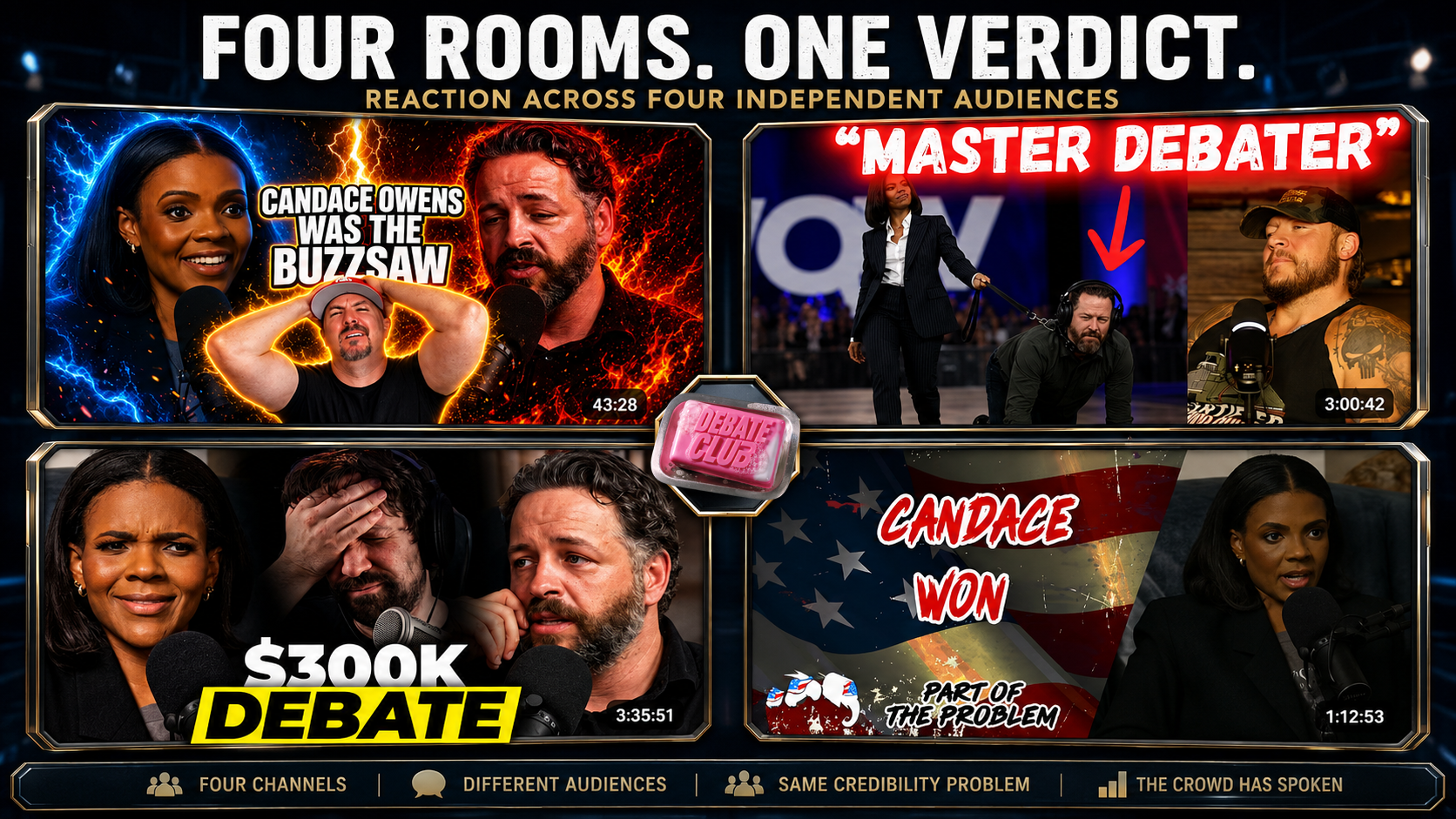
4 Reaction Channel to the Candace Owens vs Andrew Wilson Debate


.png)