The evidence trail suggests customers believed the company had removed Uncle Herschel from the kitchen. That is why Julie Felss Masino’s Good Morning America appearance became the central collapse point: she told viewers the feedback was “overwhelmingly positive,” that people liked what Cracker Barrel was doing, and that the buzz was good from customers and team members. Then the company did what companies do when the feedback is not overwhelmingly positive: it brought back the old logo, paused the remodel program, warned about weaker traffic, and started leaning back toward the food and nostalgia customers thought had been stripped out.
Cracker Barrel did have real business problems before the backlash. The company needed to address traffic, relevance, store experience, menu performance, and younger-customer appeal. Modernization by itself was not the sin. A legacy brand can update lighting, seating, operations, and menus without betraying itself. The failure was that Cracker Barrel appeared to treat nostalgia as packaging, while customers treated nostalgia as the product. The old-country atmosphere, the crowded walls, the rocking chairs, the peg games, the biscuits, the meatloaf, and the belief that the food still came from a real country kitchen were not decorative details. They were the reason people chose Cracker Barrel.
The proof chain is what makes the controversy bigger than a logo fight. Customers in the comment file called the “we’re listening” line a lie, said no one asked for the redesign, and described the new look as a soulless corporate rebrand. More importantly, the food complaints were already there: biscuits not fresh, pies store-bought, frozen or reheated food, bland meals, overcooked chicken, and confusion over what “scratch made” even meant anymore. Employee and former-employee comments added the operating-floor layer, including claims about cuts to food, inventory, chemical budgets, labor, and cleaning supplies. Outside reporting later echoed the food concern, with employee claims about day-old biscuits, microwaved meatloaf, reheated sides, and reduced prep. That is why the logo became so explosive: it gave customers a symbol for what they already felt in the dining room and tasted on the plate.
The deeper story is not that customers hate change. The deeper story is that customers recognize the corporate strip-mining pattern: raise prices, reduce labor, simplify prep, cheapen the product, polish the marketing, and rely on old brand memory to keep people paying. Cracker Barrel’s own financial record showed menu pricing doing real work before the backlash, while customers and employees were saying the food and experience felt cheaper. That does not prove every allegation in every location, and employee comments should be weighted carefully. But the pattern matters. When a company is charging for nostalgia while reducing the cost of delivering it, the brand promise starts to feel like a costume.
That is why bringing back the old logo was necessary but not enough. Putting Uncle Herschel back on the sign does not answer whether the biscuits are fresh, whether the meatloaf tastes like a kitchen made it, whether employees have enough labor and supplies to run the stores with pride, or whether customers are paying more for less while executives call it transformation. Cracker Barrel’s failure was not that it modernized too quickly. It was that customers believed the company had tried top reserve the price of nostalgia while reducing the cost of delivering it. Once customers believed Uncle Herschel had been removed from the kitchen, putting him back on the sign was only the first repair.
Complete In-Depth Analysis
The evidence trail suggests customers believed the company had removed Uncle Herschel from the kitchen.
That is why the Good Morning America interview landed so badly. Julie Felss Masino did not simply appear on national television in August 2025 to explain a logo change or a remodel plan. She appeared in the middle of a credibility crisis and told viewers that the feedback had been “overwhelmingly positive,” that people liked what Cracker Barrel was doing, and that the “buzz” was good from customers and team members. Then the company did what companies do when the feedback is not overwhelmingly positive: it restored the old logo, paused the remodel program, warned investors about weaker traffic, and started talking again about the food and nostalgia customers thought had been stripped out.
The mistake was never just visual. The new logo became the easiest thing to point at, but the deeper complaint was that Cracker Barrel had been turning into a thinner version of itself while still charging customers for the full memory. The country-store atmosphere looked like it was being cleaned out. The old logo character disappeared. Employees and customers were saying the food no longer felt scratch-made.
Reported employee claims described day-old biscuits, microwaved meatloaf, reheated sides, drastically reduced prep times, and efficiency moves that cut directly against the company’s home-cooking promise. In the uploaded Good Morning America comment file, one customer put the food complaint bluntly: “biscuits aren’t fresh, the pies are store-bought, 80% of the food is frozen and reheated.” Another asked why Cracker Barrel did not “just make the food better quality” instead of doing the redesign.
The public read the logo as evidence, not decoration. Customers did not need a branding seminar to understand what had changed. They saw a company famous for cluttered walls, rocking chairs, fireplaces, peg games, biscuits, meatloaf, country sides, and old-store atmosphere presenting itself as brighter, cleaner, simpler, and more modern. They heard Masino say the “soul of Cracker Barrel” was not changing. But the people in the comments were not reacting to one design file. They were reacting to a pattern. One commenter said the new look was a “paint-by-numbers soulless, corporate rebrand.” Another said the “whole entire point” of going to Cracker Barrel was the old-school charm. The highest-value criticism running through the comment section was not that change is always bad. It was that this specific change appeared to attack the only reason people chose Cracker Barrel over a hundred other chain restaurants.
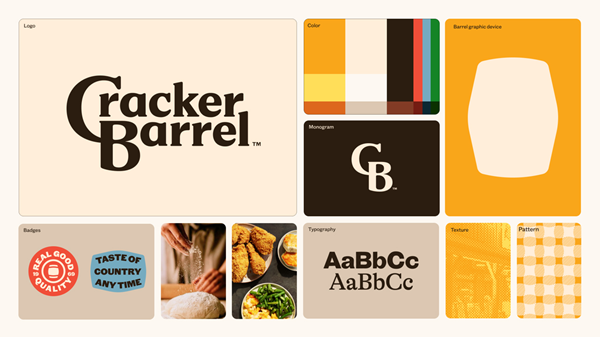
Cracker Barrel’s official 2025 visual-identity system. The redesign coordinated the wordmark, colors, typography, patterns, packaging, and presentation around a cleaner modernization strategy. Source: Cracker Barrel.
That is where the Good Morning America answer became the central moment. When Michael Strahan asked what would happen if customers wanted the old way back, Masino did not say the company was hearing mixed feedback or that it would slow down and listen. She said the feedback had been “overwhelmingly positive.” She then shifted to an anecdote about managers asking when they could get remodels. In the uploaded comments, one viewer caught the maneuver exactly: Masino had been asked about customers, but moved to store managers, then the segment ran out of time. That viewer called it a practiced answer to a “bullet question.”
The audience did not buy it. The comment file is full of people calling the “we’re listening” line a lie, asking who had supposedly requested the changes, and saying no one believed the CEO’s version of events. One of the clearest comments read, “Literally no one asked for this and no one believes you when you say they did.” Another said, “Nobody with a brain believes what that CEO just said.” A third reduced the whole interview to the line Cracker Barrel could not survive: “‘We’re listening to our guests’ That’s a lie.”
The company’s later behavior made those comments look less like internet noise and more like an early warning system. Cracker Barrel reversed the logo decision within days and brought back the Old Timer mark. Then it paused the remodel program. According to AP, traffic had already declined 1% before the simplified-logo announcement, then dropped another 8% after it. Cracker Barrel expected first-quarter traffic to fall 7% to 8% and full-year fiscal 2026 traffic to decline 4% to 7%. The company also paused remodeling efforts across its stores and said previously remodeled locations would move back toward the original decor.
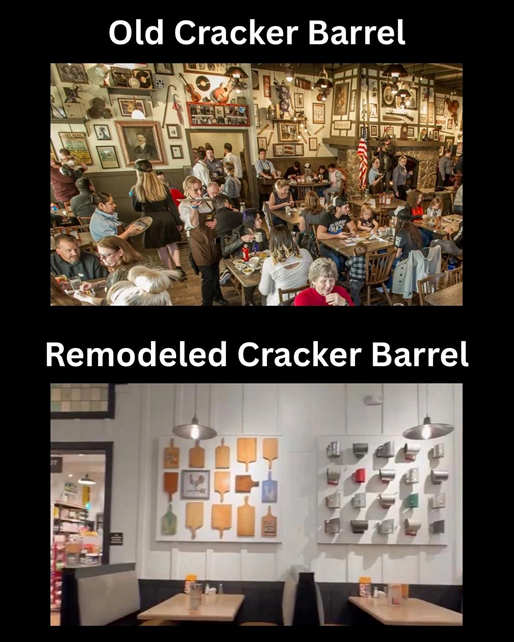
The traditional antique-filled dining room compared with the lighter, simplified remodel. This is the visual change customers were defending or rejecting—not merely a logo file. Source image circulated during 2025 remodel coverage.
That is the contradiction the interview could not outrun. If the redesign feedback was truly overwhelming, Cracker Barrel would not have stopped the redesign in its tracks. A company does not reverse a logo, pause remodels, and forecast traffic damage because the buzz is good. It does those things because the market, the customers, and the dining room have forced a correction.
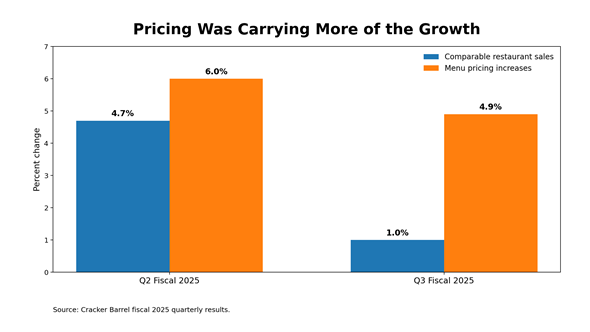
The financial record adds another layer. In the quarters leading up to the full backlash, Cracker Barrel’s comparable restaurant sales were being heavily carried by menu pricing. In Q2 fiscal 2025, comparable restaurant sales rose 4.7%, including total menu pricing increases of 6.0%. In Q3 fiscal 2025, comparable restaurant sales rose only 1.0%, including total menu pricing increases of 4.9%.
The annual report later noted that restaurant cost of goods sold fell from 26.6% of restaurant revenue in2024 to 26.4% in 2025, primarily because of menu pricing, even while absorbing commodity inflation of 2.1%. That matters because it supports the value-squeeze complaint. Customers were not simply saying “the logo is ugly.” They were saying, in effect, that the company was asking them to pay Cracker Barrel prices for a less Cracker Barrel experience. The filing language does not prove every food-quality allegation, but it does show the direction of the business pressure: price increases helped protect the economics while customers and employees were complaining that the food and experience felt cheaper.
Cracker Barrel’s quarterly disclosures showed menu pricing contributing more than comparable restaurant-sales growth in Q2 and Q3 fiscal 2025. Source: Cracker Barrel fiscal2025 results.
The food allegations are the part that gives the story its real force. The New York Post reported that employees said Cracker Barrel had quietly started serving day-old biscuits and microwaved meatloaf before the logo controversy. The Independent summarized employee claims that freshly made biscuits and meatloaf had been replaced with frozen or day-old items microwaved before serving, and that items such as bacon, green beans, turnips, pinto beans, corn, and carrots were being pre-cooked or reheated in ways employees said hurt quality.
Those claims are not cosmetic. Biscuits and meatloaf are not random menu items at Cracker Barrel. They are part of the emotional contract. A customer can forgive a chain for changing a seasonal drink, updating a chair, or adding a booth. But when the biscuit becomes a cost-control object and the meatloaf becomes a reheating process, the brand has moved from modernization into de-authentication. It is still selling the story of scratch-made country food, but the customer begins to suspect the kitchen is operating on a different script.
That suspicion was already visible in the comments. One thread questioned whether everyone was using the same definition of “scratch made,” with a reply saying “most things come in a bag now.” Another commenter said Cracker Barrel should have put more attention into the food instead of remodeling, describing the food as “bland, pasty, and just not very good.” A separate comment complained about a new dish where the breaded chicken seemed overcooked and unpleasant to eat. These are not shareholder abstractions. These are plate-level complaints: biscuits, pies, bags, frozen food, bland food, overcooked chicken, and the sense that the kitchen had lost the thing the brand kept promising.
The employee comments make the same story darker. In the uploaded comment file, a claimed night-maintenance worker said that to fund the redesigns, Cracker Barrel had cut food, inventory, chemical budgets, and labor. The commenter said managers were more honest with night maintenance because it was one of the few times they could let their emotions out without putting on a façade. A former night-maintenance employee replied that they had already seen cutting before and could not imagine cleaning with even fewer supplies. The original commenter later added that they were running out of chemicals and getting desperate to clean.
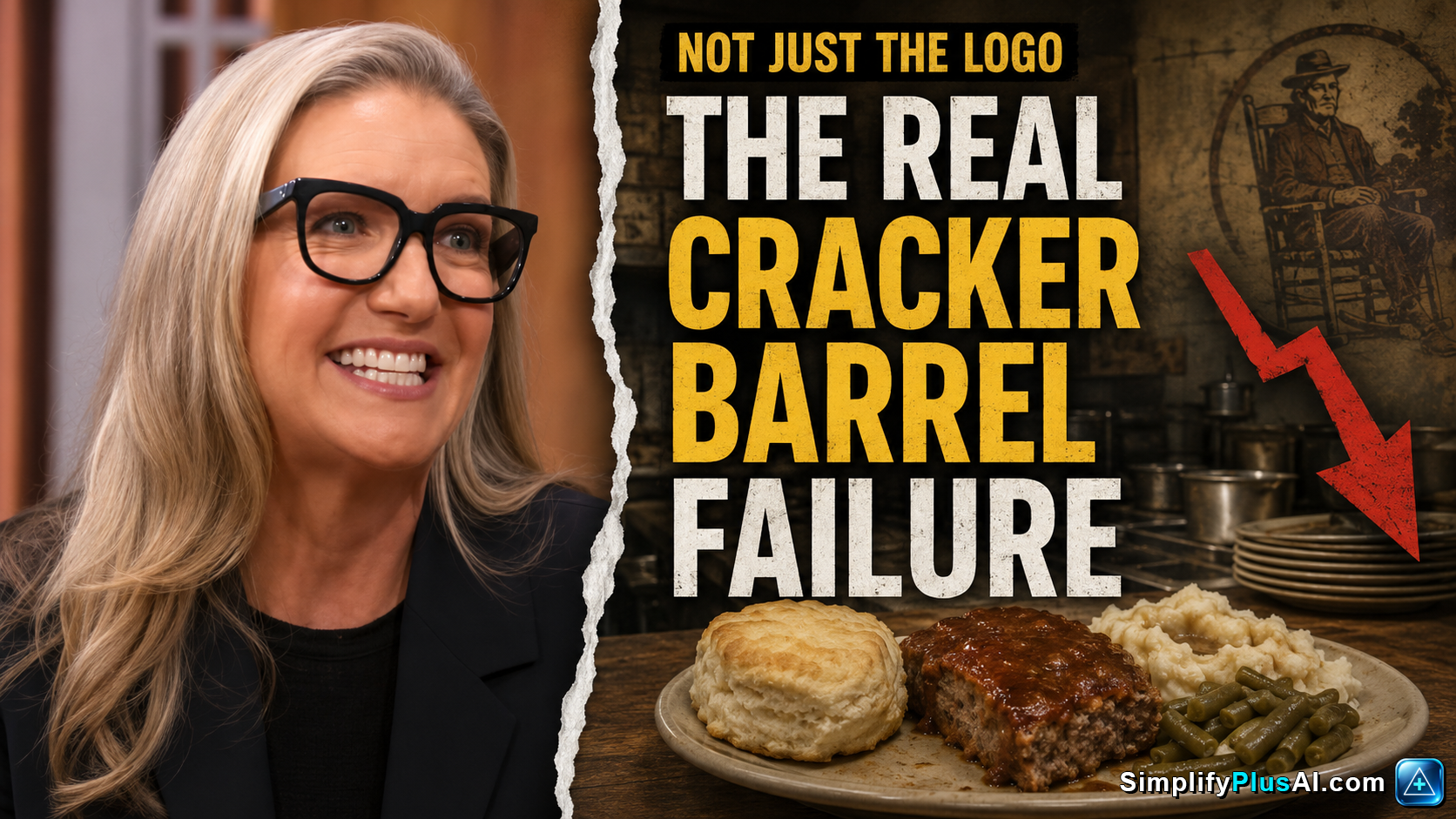
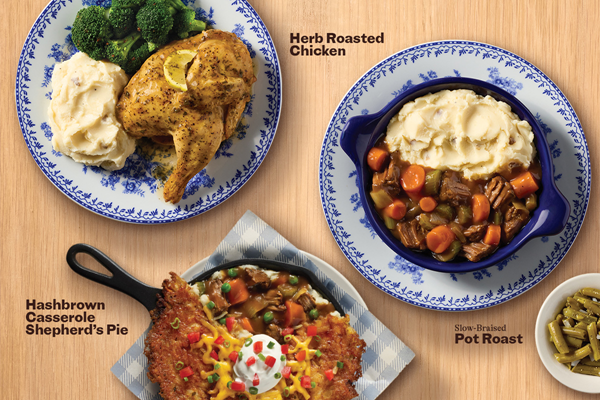
One official food image is retained because the article’s operational claim concerns whether the lived kitchen product still matched the home-cooking promise. Source: Cracker Barrel / Heidi Pearce.
That kind of comment has to be weighted carefully. It is not an audited filing. It is not a sworn deposition. It may reflect one store, one worker, one manager, or one bad operating pocket. But it matters because it matches the wider pattern: employees alleging reduced prep and reheating, customers saying the food no longer tasted fresh, corporate filings showing pricing was doing real financial work, and the company later retreating from the very design direction Masino had defended.
This is why the easy “culture war” framing is too small. The Cracker Barrel backlash certainly became political. Public figures jumped in. Some critics used ideological language. The company’s brand has long sat inside arguments about nostalgia, Americana, Southern identity, and who gets included in that memory. But the deepest business lesson is not partisan. A company can modernize without betraying itself. A company can improve lighting, fix seating, simplify operations, and still respect the product customers actually buy. What Cracker Barrel appeared to do was different: it treated nostalgia as packaging while customers treated nostalgia as the product.
The company seemed to believe the brand lived in assets: a logo, a store design, a campaign, a remodel package, a menu platform. Customers behaved as if the brand lived in continuity: the smell of the store, the crowded walls, the wait by the rocking chairs, the peg game on the table, the comfort-food staples, and the belief that the food came from a kitchen trying to cook like a country kitchen. Once that belief cracked, the logo became a confession. It said visually what customers feared operationally: the old Cracker Barrel was being simplified out of existence.
There is a fair defense of management, and it should not be ignored. Cracker Barrel was not thriving before the backlash. The company had real traffic and relevance problems. Management had a responsibility to attract younger customers, improve the store experience, address convenience, update menus, and find growth. The broader transformation plan did not come from nowhere.
But a real business problem does not excuse a bad diagnosis. The fact that Cracker Barrel needed work does not mean the answer was to strip down the atmosphere, simplify the identity, rely on price increases, and invite customers to trust that the food was still the food. The strongest version of management’s argument is that local remodel tests and internal feedback may have looked positive before the national reaction detonated. Even if that is true, it proves the deeper failure: leadership trusted controlled signals while missing the emotional ownership of the brand.
That is what made Masino’s Good Morning America appearance so damaging. She was not merely wrong about a logo. She was using corporate-confidence language against a public-trust crisis. Customers were saying the company had stopped listening. She said the company was listening. Customers were saying the redesign was soulless. She said the soul was unchanged. Customers and employees were questioning scratch-made food. She promoted menu innovation and comfort-food continuity. Then the company reversed the logo, paused remodels, and warned about traffic damage.
The market noticed. Reuters reported that Cracker Barrel shares fell as much as 13% intraday after the logo backlash before closing down 7%, with trading volume far above normal. Restaurant Dive later reported that Cracker Barrel visits fell 10% in the weeks following the logo reversal before improving to a 7% decline in the final week of September, according to Placer.ai data.
The result is a cleaner and harder story than “people got mad about a logo.” Cracker Barrel ran into the wall every legacy brand eventually faces: the pressure to improve profits without destroying the trust that makes the profits possible. The company’s own numbers show menu pricing was helping carry sales. Employees and customers were saying quality had slipped. The visual rebrand then told customers the company was not returning to its roots but moving farther from them.
This is the logic customers recognize from a thousand corporate strip-mining stories, whether or not the literal ownership structure is venture capital or private equity. The playbook feels familiar: raise prices, reduce labor, simplify prep, cheapen the product, polish the marketing, and rely on the old brand memory to keep people paying. That is why the backlash carried so much anger. Customers did not feel like Cracker Barrel had merely made a design mistake. They felt like the company was charging them for old-country cooking while quietly replacing the old-country part with reheated efficiency.
The old logo coming back was necessary, but it was never enough. Putting Uncle Herschel back on the sign does not answer whether the biscuits are fresh. It does not answer whether the meatloaf tastes like a kitchen made it or a system reheated it. It does not answer whether employees have enough labor, inventory, and cleaning supplies to run the stores with pride. It does not answer whether customers are paying more for less while executives call it transformation.
Cracker Barrel’s failure was not that it modernized too quickly. It was that customers believed the company had tried to preserve the price of nostalgia while reducing the cost of delivering it. The logo backlash exploded because it gave people a symbol for what they already felt in the dining room and tasted on the plate. Ultimately, the company did not just alter its visual identity. The true fallout revealed a public convinced that leadership had quietly priced the home-cooked soul right out of the business.
And that is why the old logo alone could never fix the damage. Once customers believed Uncle Herschel had been removed from the kitchen, putting him back on the sign was only the first repair.
Audience Temperature Gauge
679 visible comments from the Good Morning America appearance are coded by dominant reaction theme. The leading response was a collapse in corporate credibility: viewers read “we’re listening” and “overwhelmingly positive” as denial rather than reassurance.
These categories are editorial audience-reaction buckets, not scientific polling; they show why the logo dispute became a wider argument about brand identity, food quality, and operating-floor strain.
Audience Response Distribution
Breakdown of 679 coded public comments by dominant reaction theme.
679coded comments
01CEO / Corporate Credibility Collapse48.0%
02Brand Identity Stripped19.3%
03Food / Operating-Floor Decline15.5%
04Market / Business Fallout9.6%
05Culture-War / Investor Suspicion2.8%
06Boycott / Lost-Customer Threat2.4%
07Defense / Qualified Support1.3%
08Joke / Meme Reaction1.2%
Category Breakdown
Rank
Category
Count
Share
1
CEO / Corporate Credibility Collapse
326
48.0%
2
Brand Identity Stripped
131
19.3%
3
Food / Operating-Floor Decline
105
15.5%
4
Market / Business Fallout
65
9.6%
5
Culture-War / Investor Suspicion
19
2.8%
6
Boycott / Lost-Customer Threat
16
2.4%
7
Defense / Qualified Support
9
1.3%
8
Joke / Meme Reaction
8
1.2%
★Crowd Champion — Most-Liked Comment
@whoaitsreesy — 590 likes
“Hi. I HATE the new logo. It wasn’t broke. No one asked you to fix it.”
Why it matters: It gave the audience’s dominant reaction in the simplest possible form: no one asked for this, and the company was fixing something customers did not believe was broken.
✦Insight Laureate — Best Overall Comment
@monaonassis6346
“What you just heard here is what you call a bunch of corporate happy talk... You are NOT listening to your guests AT ALL... If we wanted Denny’s, we’d go there... You are destroying this iconic brand...”
Why it matters: The comment diagnosed the interview mechanics: corporate happy talk, refusal to read the room, decor as part of the product, dodged questions, and the danger of leadership ignoring clear customer rejection.
Top 5 High-Value Comments
1. Best frontline / operating-floor signal — @KrashoutKarma300
“To fund the redesigns of Cracker Barrel, they have cut the funding of every chain restaurant. They’ve cut our food, inventory, chemical budget, and our labor...”
Why it matters: Moves the backlash from “bad logo” to operating-floor strain. Treat as public testimony, not verified fact, but it is a major research lead.
2. Best brand-essence diagnosis — @NeuSocrates
“The whole entire point of going to Cracker Barrel is because of the old school charm inside. Nobody wants this soulless corporate rebranding.”
Why it matters: Explains why the redesign hit so hard: customers were protecting the reason to choose Cracker Barrel in the first place.
3. Best credibility-collapse line — @BreakerBreakerOne-Nine
“‘We’re listening to our guests’ That’s a lie.”
Why it matters: Captures the interview’s public verdict in one sentence. The audience believed the CEO’s stated reason contradicted visible customer sentiment.
4. Best case-study warning — @warmsunnytoday4535
“As a former Marketing Professor, I smell another case study of what not to do.”
Why it matters: Captures the business-school read: a live failure in brand stewardship, customer listening, and modernization without brand literacy.
5. Best food-authenticity signal — @Eddie-rm4xc
“Goodbye, Cracker Barrel... biscuits aren’t fresh, the pies are store-bought, 80% of the food is frozen and reheated!... headed to the mom and Pop diner down the street!”
Why it matters: Connects the article’s deepest point: customers were not only rejecting the visual rebrand; they were saying the food promise had been hollowed out.
Arena Read
The crowd reaction was not simply that people hated the new logo. The dominant response was a credibility collapse around the CEO’s Good Morning America appearance: viewers heard “we’re listening” and “overwhelmingly positive” as corporate denial, not reassurance.
The strongest comments added the operating-floor and food layer, showing that customers believed the old-country identity, the kitchen promise, and the experience were being stripped together.
Comment Selection Disclaimer
Comments are selected for clarity, insight, public reaction, factual relevance, or contribution to the discussion. Selection does not endorse, investigate, validate, or judge the person who posted it. We are evaluating the comment, not certifying the commenter.




.png)
1. Best frontline / operating-floor signal — @KrashoutKarma300
“To fund the redesigns of Cracker Barrel, they have cut the funding of every chain restaurant. They’ve cut our food, inventory, chemical budget, and our labor...”
Why it matters: Moves the backlash from “bad logo” to operating-floor strain. Treat as public testimony, not verified fact, but it is a major research lead.
2. Best brand-essence diagnosis — @NeuSocrates
“The whole entire point of going to Cracker Barrel is because of the old school charm inside. Nobody wants this soulless corporate rebranding.”
Why it matters: Explains why the redesign hit so hard: customers were protecting the reason to choose Cracker Barrel in the first place.
3. Best credibility-collapse line — @BreakerBreakerOne-Nine
“‘We’re listening to our guests’ That’s a lie.”
Why it matters: Captures the interview’s public verdict in one sentence. The audience believed the CEO’s stated reason contradicted visible customer sentiment.
4. Best case-study warning — @warmsunnytoday4535
“As a former Marketing Professor, I smell another case study of what not to do.”
Why it matters: Captures the business-school read: a live failure in brand stewardship, customer listening, and modernization without brand literacy.
5. Best food-authenticity signal — @Eddie-rm4xc
“Goodbye, Cracker Barrel... biscuits aren’t fresh, the pies are store-bought, 80% of the food is frozen and reheated!... headed to the mom and Pop diner down the street!”
Why it matters: Connects the article’s deepest point: customers were not only rejecting the visual rebrand; they were saying the food promise had been hollowed out.