SIMPLIFYPLUSAI | INSIGHTS AND ARTICLES

Dan Orlovsky “What Big Games?” and the Cost of Unearned Certainty

PREPARATION • FACT CONTROL • SCOUTING • CREDIBILITY

Article Overview

Dan Orlovsky’s Ty Simpson argument did not collapse because he preferred the wrong quarterback. It collapsed when Pat McAfee pressed him on Fernando Mendoza’s biggest-game résumé and Orlovsky answered, “What big games?” That was the moment the debate stopped being a normal draft disagreement and became a structural credibility event. The room knew the answer immediately: Ohio State, Oregon, Alabama, Miami, a Big Ten Championship, a Rose Bowl, a Peach Bowl, a national title game, and a head-to-head playoff blowout against the exact quarterback Orlovsky was elevating.

The fair version matters. Orlovsky was allowed to prefer Simpson’s NFL projection over Mendoza’s college résumé. Projection-versus-production is a legitimate scouting argument, and college dominance does not guarantee Sunday success. A serious analyst could question Mendoza’s translatability, ask for more tight-window throws, or argue that Indiana’s structure protected him in ways that might not carry to the NFL. The problem was not the existence of a contrarian take. The problem was that the take carried more certainty than the preparation underneath it could support.

The proof chain made the moment damaging. Orlovsky had built public skepticism around Mendoza after reviewing only part of the data, then defended the position as if the late-season pressure sample did not change the burden. He got the Ohio State game situation wrong, arguing Indiana had only six points through three quarters when Mendoza’s third-quarter touchdown had already put Indiana ahead 13–10. Then came the evidence he could least afford to minimize: Mendoza beating Alabama in the playoff while Simpson was the opposing quarterback, followed by Indiana taking down Oregon and Miami to finish the championship run. The CAA connection added another trust layer. Shared representation does not prove the take was compromised, but it raised the price of sloppiness. In that environment, the data had to be complete, the facts had to be right, and the strongest counterevidence had to be handled before the audience handled it for him.

That is why this story matters beyond sports television. A hot take is not the problem. Unearned certainty is the problem. Merril Hoge’s Johnny Manziel criticism shows the difference: brutal, unpopular, but built on a football mechanism that could survive scrutiny. Joe Rogan’s Ronda Rousey walk-back shows another version of the standard: when a claim clearly overreaches, admit it and recalibrate. Orlovsky missed both lanes. He did not have the full data ready when challenged, misstated a key fact while defending the take, had an appearance-of-conflict problem in the background, and failed to reset once the room made the collapse obvious.

People can forgive a bad prediction. They can forgive a bold opinion that misses. What they have a harder time forgiving is certainty that was never ready for the spotlight. The full article follows the evidence trail through Orlovsky, Mendoza, Simpson, CAA, Hoge, Rogan, Ohio State, Alabama, Oregon, Miami, and the pressure of live commentary, but the core failure is already visible in those three words. Not that Orlovsky was wrong. That he was too sure, too soon — with the wrong facts, incomplete data, an appearance-of-conflict problem, and no recalibration when the argument collapsed live and in real time.

The Three Words That Changed the Segment

Dan Orlovsky did not get buried because he liked the wrong quarterback. He got buried because of three words.

“What big games?”

That was the moment the argument stopped being a routine draft disagreement and became a structural credibility event. Pat McAfee was pressing Orlovsky about Fernando Mendoza’s résumé — about the stages where the Indiana quarterback had already carried the weight Orlovsky seemed to be discounting. Orlovsky, defending Ty Simpson as his preferred prospect, pushed back by questioning the very existence of Mendoza’s big-game evidence. It landed like a man arguing from memory in a room full of people holding the receipts.

The room knew the answer before he finished the sentence: Ohio State, Oregon, Alabama, Miami, a Big Ten Championship, a Rose Bowl, a Peach Bowl, and a national title game. It included a head-to-head playoff blowout against the exact quarterback Orlovsky was elevating.

The problem was not that Orlovsky had a contrarian opinion. Contrarian opinions are necessary. Strong analysis often begins when someone is willing to see what the consensus missed. The problem was that this opinion carried more certainty than the preparation underneath it could support.

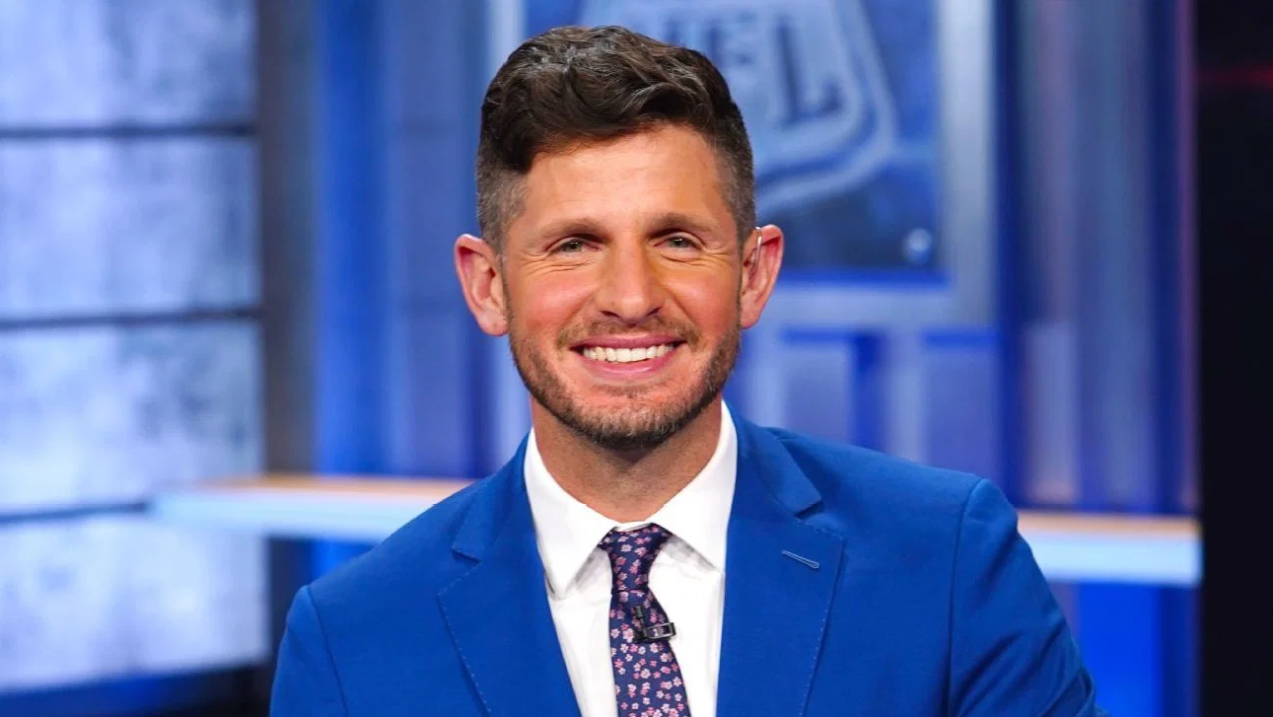
Dan Orlovsky, the ESPN analyst whose high-certainty Ty Simpson preference became the center of the live credibility dispute.

That is why the clip mattered far beyond daytime sports entertainment. It was a live demonstration of what happens when commentary outruns the work beneath it. Orlovsky had every right to prefer Simpson’s raw NFL traits, and he had every right to question whether Mendoza’s college production would translate cleanly to Sundays. But if an analyst is going to challenge an obvious résumé, dismiss a consensus prospect, and defend an unpopular position on a national stage, the entry standard rises. The facts must be right. The counterevidence must be absorbed. The biggest games on the schedule have to be accounted for before the room has to name them for you.

The Sequence Error: Certainty Before the Full Sample

Orlovsky’s first systemic error was sequence. He built public skepticism around Mendoza after reviewing only part of the data. In February, his initial commentary noted that he had watched eight games, found Mendoza’s tape underwhelming, criticized a lack of “big-time throws,” and asserted that Ty Simpson’s first eight games at Alabama were significantly more impressive. The fatal flaw was the timing: Orlovsky had not yet watched the final stretch of Mendoza’s season — the precise pressure sample central to the evaluation.

A serious analyst can say, “Through eight games, I have questions.” That is fair. It is transparent. It tells the audience exactly where the evidence starts and where it stops. But the moment that early evaluation hardens into a high-certainty public claim, the burden shifts. The opinion is no longer a working notebook entry. It is a position. And once a position is taken, it must survive the full record, not just the slice of data that formed the first impression.

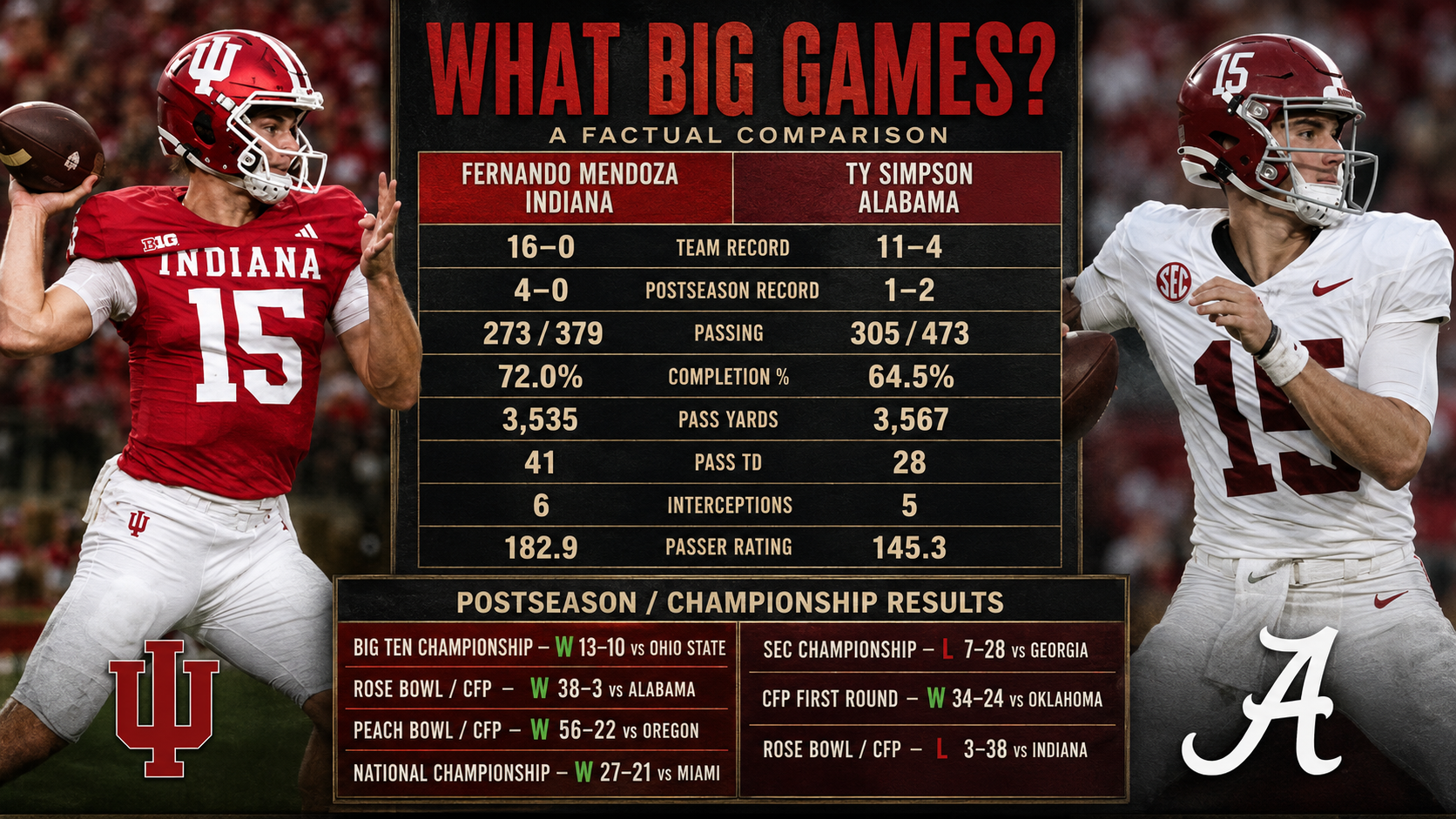
Fernando Mendoza — production, pressure résumé, and championship-stage evidence vs. Ty Simpson — tools, projection, and the traits-based case Orlovsky preferred.

The Big-Game Record

The missing part of Mendoza’s season was not late-season filler against weak opponents. It was the crucible of his entire evaluation. Mendoza beat No. 1 Ohio State in the Big Ten Championship, a game Indiana secured 13–10 after his third-quarter touchdown pass broke the stalemate. That mattered because the Buckeyes were not just a ranked opponent. They were an undefeated, NFL-loaded roster and the defending national champions.

Orlovsky’s defense did not merely underweight that championship game. He misstated the underlying fact. He argued that Indiana had only scored six points through three quarters, but the record shows Mendoza’s touchdown had already put Indiana ahead 13–10 in the third. This is the credibility floor. Before the interpretation, before the projection, and before the trait argument, the foundational fact must be correct. If the supporting fact fractures, the audience stops trusting the analytical engine built above it. A wrong fact in a low-stakes conversation is a mistake. A wrong fact used to defend a high-certainty contrarian take is structural damage.

Then came Alabama — the direct, head-to-head comparison Orlovsky’s case could least afford to wave away. Mendoza did not just play a brand name in the Rose Bowl. He faced Simpson’s own team in the College Football Playoff. Indiana won 38–3. Mendoza operated with near-flawless efficiency. Simpson’s afternoon ended early due to injury, a critical variable that belongs in a fair assessment, but the injury does not erase the systemic problem with Orlovsky’s argument. If the analyst’s case positions Simpson over Mendoza, and the two share a playoff field where Mendoza’s offense completely dismantles Alabama, that game cannot be treated like a historical anomaly. It is central evidence. It may not definitively settle the NFL translation, but it cannot be omitted from the model.

The sequence continued through Oregon and Miami. Indiana’s postseason run required Mendoza to walk directly through the season’s most hostile environments. Mendoza’s case was built explicitly out of big games.

Had the critique been more refined, it could have been a legitimate football argument. An analyst could have argued that Indiana’s heavy play-action structure and schemed design protected Mendoza. They could have pointed out that his best college answers, built around pre-snap clarity and clean pockets, might not translate cleanly to Sundays. They could have asked to see more tight-window throws into muddy coverage, or questioned his processing speed when the initial read was capped. Those are mechanical, film-based arguments. They may be right or wrong, but they are aimed at the real question.

Mendoza’s Big-Game Résumé: All Wins

OpponentStageResultWhy It Matters
Ohio StateBig Ten ChampionshipWIN 13–10Mendoza’s third-quarter touchdown put Indiana ahead.
AlabamaRose Bowl / CFPWIN 38–3Direct head-to-head against Simpson’s team; Mendoza threw three touchdowns.
OregonPeach Bowl / CFPWINAnother elite postseason pressure test.
MiamiNational ChampionshipWINCompleted Indiana’s undefeated title run.

The language is exact: every listed game was a win. Alabama was not merely “competitive”; Indiana won 38–3.

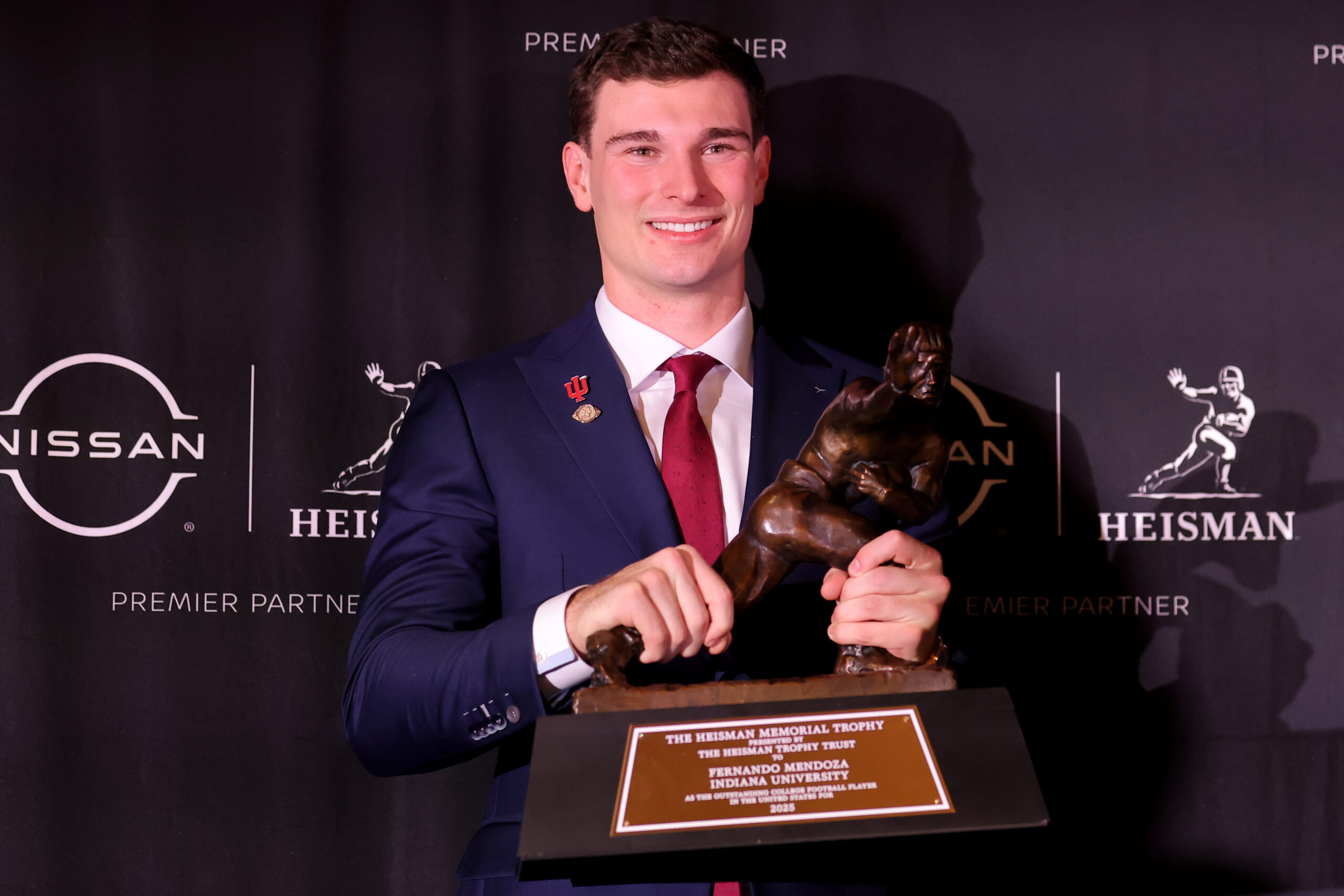
Fernando Mendoza became the public face of the résumé Orlovsky’s “What big games?” question appeared to overlook.

“What big games?” did something else. It revealed that the analyst had failed to locate the baseline evidence.

The CAA Trust Layer

There was also another layer, and it has to be handled carefully. Orlovsky and Simpson were both connected to Creative Artists Agency, a fact that became part of the public reaction to the segment. Orlovsky rejected the implication that CAA had influenced his opinion, saying CAA had never asked him to say anything and that the agency works for him, not the other way around. That defense matters. There is no public evidence that CAA ordered, purchased, or directed the take.

But conflict analysis does not end at direct instruction. In modern sports media, agencies do not merely negotiate contracts in the background. They shape access, relationships, narratives, and career ecosystems. A shared agency does not prove bad faith, but it does change the trust environment. When an analyst aggressively elevates a player represented inside the same broader talent network, the opinion has to be cleaner than clean. The data has to be complete. The facts have to be right. The strongest counterevidence has to be handled before the audience handles it for him.

That is why the CAA layer matters. It is not proof that Orlovsky’s opinion was corrupted. It is the reason the process failure carried more risk. If there is even an appearance of alignment, the analyst’s best protection is visible discipline: full preparation, factual control, transparent uncertainty, and a willingness to recalibrate when the argument breaks. Orlovsky did not give the audience that protection.

ProFootballTalk framed the broader media machinery around the debate in similar terms, noting that large agencies, draft clients, broadcasters, and media narratives can overlap in ways that fuel the take machine even without proving a direct quid pro quo. That is the responsible way to read the CAA angle. It is not the cause of the collapse. It is the trust multiplier that makes the collapse more damaging.

What an Earned Contrarian Opinion Looks Like

There is nothing wrong with a hot take if the take has a spine. The best contrarian opinions are not random acts of defiance. They are pressure-tested arguments that anticipate the audience’s easiest counterpoints before they are even raised. They survive the first hard question because the structural work has already been completed.

Merril Hoge’s 2014 Johnny Manziel evaluation is the clean contrast. Hoge did not make a safe, crowd-pleasing claim. Before the draft, he stated that Manziel had “bust written all over him,” arguing his skill set would not transition to the NFL. He did not focus on celebrity noise or hype. He isolated a specific football mechanism: Manziel’s eyes dropping under pressure, his chaotic pocket discipline, and his unsustainable reliance on out-of-structure play against NFL defensive speed.

When Manziel’s Cleveland tenure fractured along those exact fault lines, Hoge went even harder, saying the Browns needed to cut bait and evaluate the personnel department that drafted him. You can dislike Hoge’s tone, but you cannot argue his structure. He was not trying to win a television segment by sounding different. He staked a scouting claim against an institutional decision, backed by a repeatable tape-evaluation mechanism.

Joe Rogan’s Ronda Rousey comments offer the inverse lesson in credibility preservation. Rogan once famously asserted that Rousey could beat half of the UFC men’s bantamweight division, a wild hyperbole that completely outran the evidence. But when the competitive landscape changed, Rogan publicly admitted the claim was an unearned overreach. Credibility is not built solely by maintaining an unbroken record of perfection. It is also built in the correction. When the evidence changes or the claim clearly overreaches, the honest move is to recalibrate.

The Exit Ramp Orlovsky Missed

That was the exit ramp Orlovsky missed.

The moment “What big games?” left his mouth, the segment gave him an immediate window to lower his certainty. He could have said, “Fair point. I need to finish the late-season tape. I still favor Simpson’s vertical arm talent and off-platform traits, but I can’t dismiss Mendoza’s postseason record without fully evaluating those games.” That would not have ended the debate, but it would have preserved his process discipline. The room would have watched an analyst adjust his model to incoming evidence in real time.

Instead, the argument kept driving forward over the fracture.

There is a scene in Swingers that captures this exact behavioral meltdown without needing a line from the script. A man gets a woman’s number, calls her, leaves an awkward message, panics, and calls back instantly to repair the first message — repeating the loop until each new intervention multiplies the damage of the original failure. The cringe does not come from the first awkward move. It comes from the total inability to stop when everyone knows the moment has gone cold.

That is the behavioral loop of the McAfee segment. “What big games?” was the first voicemail. The flawed Ohio State fact was the second. The continued defense against the reality of the Alabama, Oregon, and Miami games was the third, fourth, and fifth. At a certain point, the technical content of the defense mattered less than the visible panic of a person refusing to put down the phone.

Reading the room is not pandering or surrendering to a loud crowd. It is recognizing when new evidence has fundamentally changed the state of the argument. The room was not merely booing a contrarian perspective. It was pointing out that his model had just run directly into a concrete wall of unabsorbed facts.

If Orlovsky wanted to sustain his ranking, he needed to move away from résumé denial and transition into granular translation detail. He needed to show exactly which NFL-level throws Simpson made from a compressed pocket that Mendoza could not replicate. He needed to prove why Indiana’s scheme artificially inflated Mendoza’s numbers, and why the head-to-head outcome was an outlier rather than a definitive data point. He needed to turn a daytime hot take into a rigorous scouting case.

That is the work.

The Cost of an Earned Opinion

The phrase “earned opinion” sounds simple until it costs you something. It costs speed. It costs the immediate gratification of high certainty. It costs the ego hit of admitting your data is incomplete. It requires the humility to correct a factual error before the audience has to force the correction upon you.

It also requires an awareness of trust conditions. If no appearance of conflict exists, preparation matters. If an appearance of conflict does exist, preparation matters even more. Shared representation does not prove an opinion is compromised, but it raises the price of sloppiness. In that environment, wrong facts and incomplete data do not merely weaken the take. They make the audience wonder what else shaped the take before the evidence did.

Why the Lesson Extends Beyond Sports Television

This is not just a sports-media blooper. It is a pure signal-quality case study. In operations, software architecture, corporate leadership, system design, and public commentary, professionals make versions of this sequence error every day. They see an early data pattern and overstate it. They build an architecture before the edge cases are analyzed. They use a corrupted supporting fact and defend the entire model as if the foundation has not buckled. They treat confidence as a substitute for verification.

But confidence is only useful when it sits on completed work. A rushed take sounds sharp for thirty seconds. A prepared take survives the room.

The discipline is not to avoid boldness. That is cowardice masquerading as caution. The discipline is knowing exactly which category of boldness you are deploying. There is earned boldness, the kind Hoge used to diagnose Manziel’s mechanical transition risks. There is repairable exaggeration, the kind Rogan used to recalibrate his baseline. And there is exposed certainty, which occurs when an analyst forces a high-volume conclusion before the strongest evidence has been handled.

Orlovsky’s take was exposed certainty.

That does not render him an incompetent analyst, nor does it mean Ty Simpson can never become a superior professional quarterback. NFL draft history is littered with consensus failures. A player can possess an immaculate college résumé and still stall out on Sundays, while a traits-heavy prospect looks brilliant three years later.

But future variance does not retroactively rescue a broken process. Even if Simpson eventually wins a Super Bowl, “What big games?” remains a broken question. Even if Mendoza struggles as a pro, the Ohio State support point was factually wrong. And even if CAA had no influence whatsoever, the shared-agency appearance still meant Orlovsky owed the audience a cleaner process, not a messier one.

The Standard Is Preparation

The standard is not perfection. It is preparation.

The individuals who speak with authority must earn it on every single turn. They earn it by verifying the data before arguing the interpretation, by understanding the strongest counterarguments before asking others to trust their model, by recognizing when background relationships raise the burden for visible independence, and by stopping the engine when a fault light appears on the dashboard instead of simply talking louder over the crack.

Say the bold thing if the work is underneath it. Make the unpopular case if your architecture can survive the first hard question. But do not enter the room with incomplete data, a full-volume conclusion, and an appearance-of-conflict problem, then act surprised when the room hears exactly what is missing.

At 11:10, the segment breaks open. Dan Orlovsky challenges Fernando Mendoza’s résumé with the now-infamous question: “What biggest games?” It is difficult to find a worse sports take delivered with that much certainty. The comment ignored Mendoza’s championship-stage résumé and became the moment the discussion—and Orlovsky’s credibility within it—came apart.

The damage compounded. At 20:23, someone off camera says, “Stop crying,” underscoring how painful the exchange had become. Orlovsky then followed the original claim with factual in-game errors, including getting details of the Ohio State game wrong. By that point, the issue was no longer a debatable draft preference; it was a visible failure of preparation.


Corrections and Accuracy

If you notice a factual error or inaccuracy in this article, please notify us at contact@simplifyplusai.com. We will review the information and update the article where appropriate.

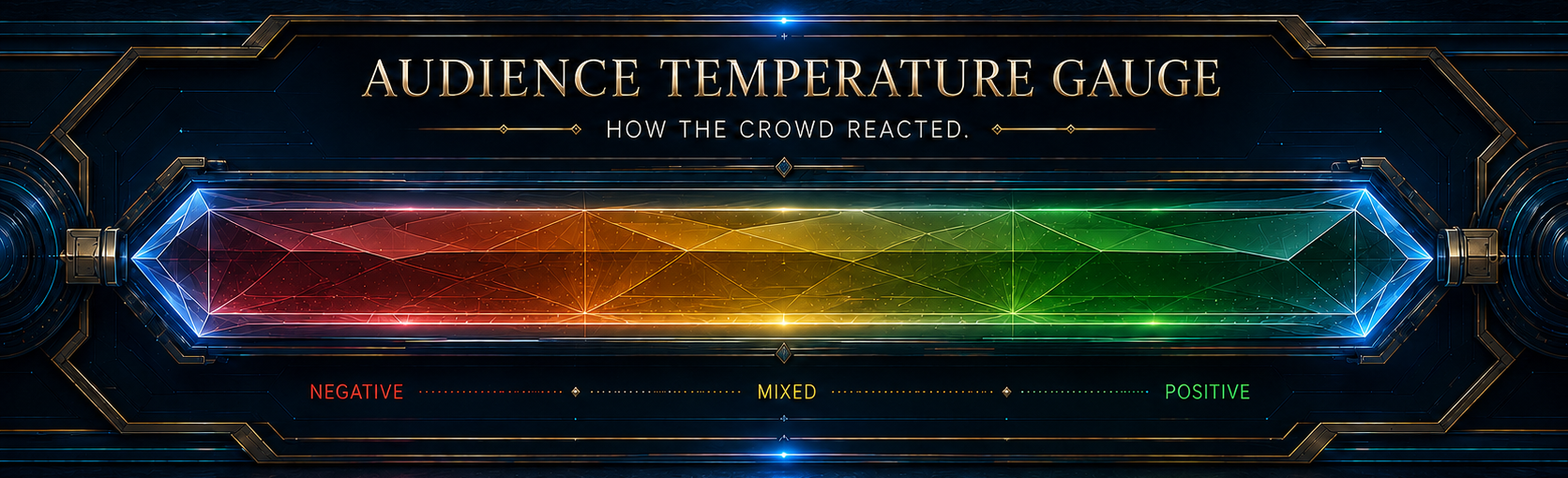
Audience Temperature Gauge

1,645 visible comments on the “What big games?” segment are coded by dominant reaction theme. The leading response was that Dan Orlovsky’s take became the punchline because the question made the preparation gap visible.

These categories are editorial audience-reaction buckets, not scientific polling. Of 1,910 parsed comment blocks, 265 duplicates, off-topic, broken, unreadable, fragmented, or low-signal comments were excluded.

Audience Response Distribution

Breakdown of 1,645 coded public comments by dominant reaction theme.

01Dan Take Became the Punchline59.5%
02Quarterback Scouting Debate20.4%
03Conflict-of-Interest / Media Agenda Suspicion6.3%
04Mendoza Big-Games Rebuttal4.7%
05Pat Room Roasting / Clip Entertainment3.5%
06Dan Defense / Pile-On Pushback2.8%
07Ty Simpson Support / Mendoza Doubt1.3%
08Side Draft / CFP Tangents1.1%

Category Breakdown

RankCategoryCountShare
1Dan Take Became the Punchline97959.5%
2Quarterback Scouting Debate33620.4%
3Conflict-of-Interest / Media Agenda Suspicion1036.3%
4Mendoza Big-Games Rebuttal774.7%
5Pat Room Roasting / Clip Entertainment573.5%
6Dan Defense / Pile-On Pushback462.8%
7Ty Simpson Support / Mendoza Doubt221.3%
8Side Draft / CFP Tangents181.1%

Crowd Champion — Most-Liked Comment

@cookSkiMonster — 1.5K likes

“What big games?” — Dan Orlovsky about a team that won a national championship and didn’t lose a game all season.

Why it matters: This comment captured the audience’s simplest rebuttal: the phrase “What big games?” sounded absurd because Mendoza’s case was built around exactly that kind of résumé.

Insight Laureate — Best Overall Comment

@Tnredneckdad

“‘What big games’ is perhaps the single dumbest phrase ever echoed on a sports show... To go on shows and not concede that it is a radical take while trying to take away from Mendoza’s accomplishments is just utterly stupid... all evidence goes against him.”

Why it matters: This comment moved beyond mockery and identified the article’s central distinction: a contrarian preference is allowed, but certainty has to be earned by the evidence structure underneath it.

Top 5 High-Value Comments

1. Best situational-awareness metaphor — @Cardsone1

“Dan really stepped out of the back of the endzone on this one!”

Why it matters: It turned Orlovsky’s own NFL history into a visual metaphor for the take: not simply being wrong, but losing awareness of where the argument had gone.

2. Best role-standard distinction — @Mike-G-15

“Pat’s job isn’t to be an objective talent evaluator, but Dan’s job is... that’s the whole point...”

Why it matters: This comment explained why the burden was different for Orlovsky. Pat can be a broadcaster with a bias; Orlovsky’s credibility depends on analyst-level preparation and evidence standards.

3. Best fair scouting pushback — @gsukjdakid

“Ask yourself, if you put Ty Simpson on Indiana, do they still win a championship? Indiana definitely had a better overall team than Alabama. I believe Mendoza is better, but I don’t think he’s head and shoulders over Simpson... I wouldn’t slander Dan for this take.”

Why it matters: This was the best counterweight to the pile-on. It gave Simpson a plausible case without pretending the public reaction to Orlovsky’s certainty did not happen.

4. Best evidence-summary rebuttal — @1JN3MO

“Fernando elevated Indiana to national champions with ZERO 5-stars. Ty elevated his team to a 38-3 blowout loss to Indiana with NINE 5-stars.”

Why it matters: This comment compressed the Mendoza-versus-Simpson argument into a simple supporting-cast and outcome comparison. It is blunt, but it shows why many viewers saw the take as upside down.

5. Best appearance-of-conflict signal — @ImJustHereForWhatAllTheRealExp

“Conveniently Orlovsky and Simpson share the same sports agency.”

Why it matters: This does not prove bad faith, but it shows why the shared-representation issue mattered to the audience. Once that suspicion entered the room, the factual burden on Orlovsky became even higher.

Arena Read

The audience reaction was not simply that people disagreed with Dan Orlovsky’s quarterback ranking. The dominant response was that the take became the punchline because “What big games?” made the preparation gap visible. Viewers did not hear a careful projection-versus-production argument. They heard an analyst dismiss the pressure résumé that many believed defined Fernando Mendoza’s case.

Beneath the jokes, the crowd repeatedly returned to evidence standards: the championship run, the Alabama head-to-head, the Ohio State game-state error, the supporting-cast comparison, and the appearance-of-conflict concern. The strongest comments were not merely laughing at a bad take. They were saying the argument had crossed from contrarian into underprepared.

That is the useful public signal. People can forgive a wrong prediction and some commenters defended Orlovsky’s right to prefer Simpson. What they were less willing to forgive was certainty without enough preparation, especially once the room supplied the missing evidence in real time.

Comment Selection Disclaimer

Comments are selected for clarity, insight, humor, public reaction, factual relevance, or contribution to the discussion. Selection does not endorse, investigate, validate, or judge the person who posted it. We are evaluating the comment, not certifying the commenter.

Back to Articles