Right Now, AI Is an Enhancement Tool — Not a Replacement Tool
AI REALITY CHECK • OPERATIONS • WORKFORCE • TRUST
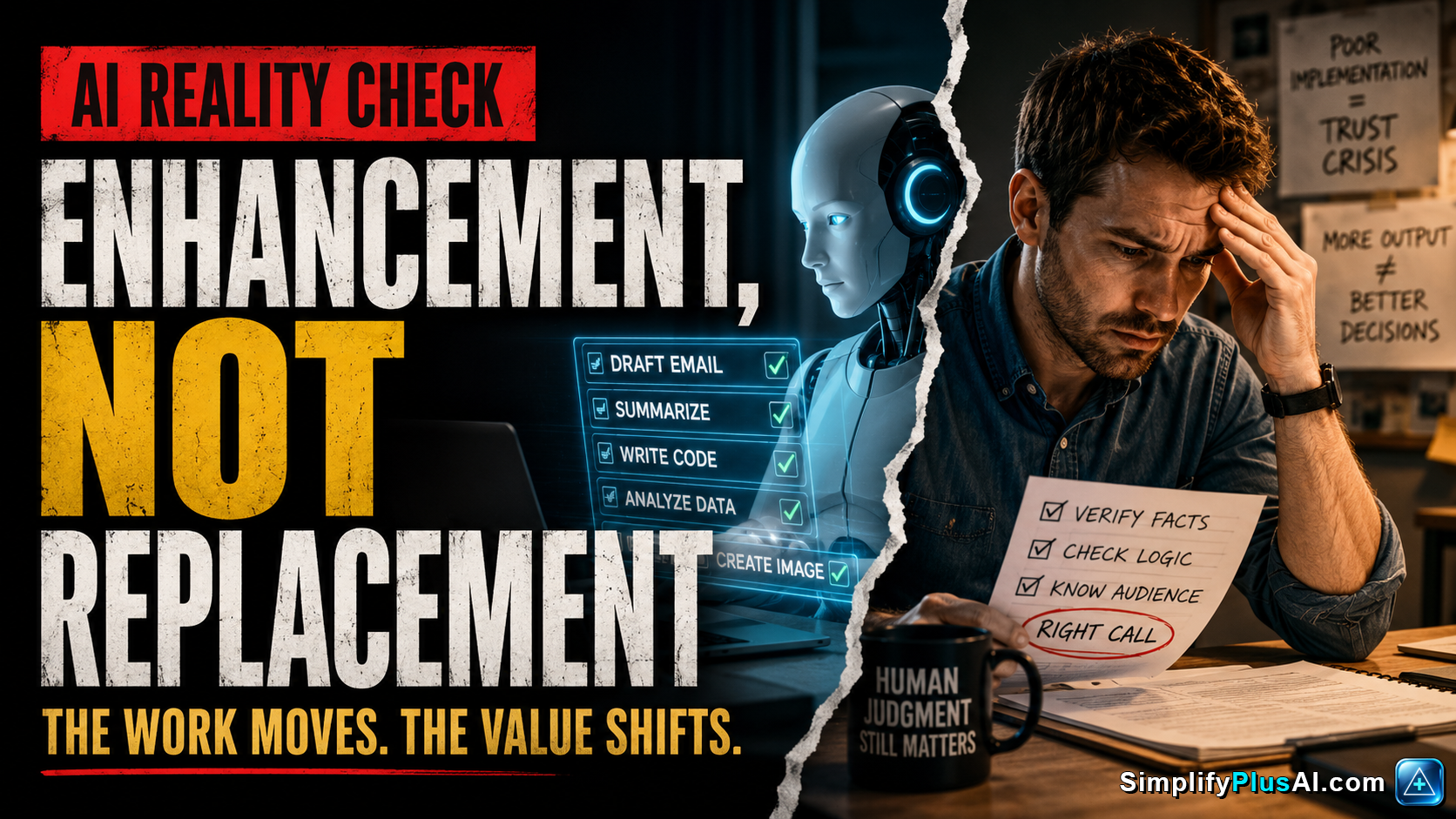
AI can move the work without removing the need for human judgment.
ARTICLE OVERVIEW
A new tool does not have to destroy the world to destroy someone’s version of the world. That is the part people miss when the AI debate collapses into two lazy corners: one side says the technology will ruin everything, while the other says progress always works out, so resistance is pointless. Both miss the harder truth. Technology does not arrive evenly. It changes the value of work, and once that happens, the old job map starts moving under people’s feet.
Companies have legitimate reasons to study AI because it can reduce administrative drag, compress research cycles, accelerate drafting, and improve certain workflows. Workers have equally legitimate reasons to feel exposed when the same tool is introduced mainly through headcount reduction, replacement, and entry-level job erosion. History offers fair context: automobiles weakened the horse-based economy while creating mechanics, dealerships, trucking, insurance, road construction, and modern logistics; computers and the internet erased some forms of office work while creating software, cybersecurity, digital marketing, e-commerce, cloud systems, analytics, and remote work. The shift can create enormous value without making displacement painless.
AI carries a sharper edge because it reaches writing, analysis, coding, design, communication, customer service, research, and other thinking-shaped work. It can make a capable person faster while making an unprepared person look capable for a while. A polished answer is not always a good answer, a clean design is not always effective, and a fast report is not always reliable. The operational receipts already show the limit: inventory systems still need people when physical reality breaks the model, chatbots still need escalation paths, and internal tools still need clean data, cost controls, legal boundaries, customer testing, and quality assurance. AI deployment is harder than AI promotion.
The deeper value is therefore not production alone; it is evaluation. AI multiplies the system around it. Strong judgment becomes faster, organized data becomes more useful, and clear workflows gain leverage. Weak systems produce faster hallucinations, faster customer frustration, faster brand damage, and faster internal confusion. That is why the replacement narrative creates a trust crisis. Workers can understand a tool that removes repetitive work or improves decision quality. The same tool becomes threatening when leadership treats an unfinished enhancement layer as a payroll-reduction machine before it has earned operational reliability.
Right now, AI is an enhancement tool, not a replacement tool. That is not a timid position; it is the serious strategic position. Replacement will occur in specific tasks, roles, and workflows, but businesses still need human review, accountability, customer trust, legal responsibility, operational knowledge, and quality control. The companies and workers that succeed will be the ones that adapt without surrendering judgment, pursue efficiency without destroying trust, and use AI to strengthen the system instead of pretending the system no longer needs people.
Complete In-Depth Analysis
The Work Moves
A new tool does not have to destroy the world to destroy someone’s version of the world.
That is the part people miss when they argue about technology. The debate usually gets forced into two lazy corners. One side says the new tool will ruin everything. The other side says progress always works out, so stop complaining. Both miss the harder truth. Technology does not arrive evenly. It does not hurt everyone the same way. It does not help everyone at the same speed. It changes the value of work, and once that happens, the old job map starts moving under people’s feet.
That is the real story with AI. It is not the first tool to make workers nervous, and it will not be the last. But it is hitting a more sensitive layer because it touches writing, analysis, coding, design, communication, customer service, research, and judgment. Earlier tools changed how people moved, copied, calculated, communicated, and sold. AI is changing how people produce thinking-shaped work.
The current transition carries a specific kind of pressure. Companies have a legitimate reason to study AI because the technology can reduce administrative drag, compress research cycles, speed up drafting, and make certain workflows faster. Workers also have a legitimate reason to feel exposed because the same technology is being discussed in terms of headcount, replacement, and entry-level job reduction. That fear is not abstract. It is about rent, car payments, family obligations, student debt, and the basic ability to sustain a life.
That is why the rollout matters. Poor implementation turns a productivity tool into a trust crisis. When leaders introduce AI mainly as a cost-cutting weapon, employees hear a threat. When critics treat every failed deployment as proof that the technology is useless, they miss the real leverage. Both reactions can harden into bad judgment. The serious position is not anti-AI or pro-replacement. The serious position is sound business practice: understand what the tool can do, what it cannot do, what it changes, and what human judgment still has to protect.
Technology Changes the Map
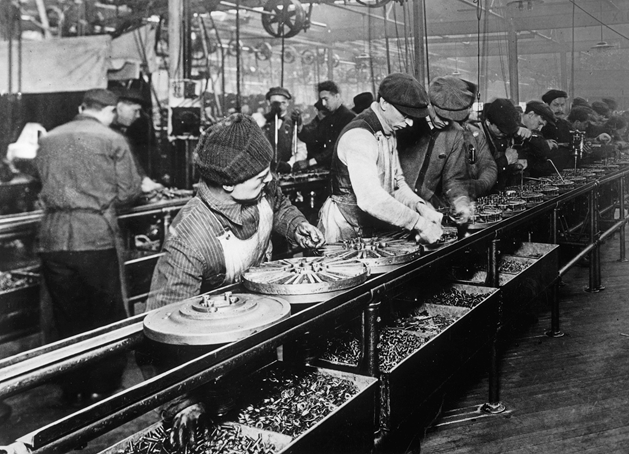
Workers onFord’s first moving assembly line in Highland Park, Michigan, 1913.Public-domain image via Wikimedia Commons.
The pattern is older than AI. The automobile did not simply replace the horse; it weakened an entire horse-based economy. Carriage makers, stable workers, horse handlers, feed suppliers, and blacksmiths tied to horse transport did not automatically become mechanics or truck drivers. Adaptation sounds clean when viewed from a century away. It is much harder when the shift is happening inside a person’s actual paycheck, identity, and skill set.
But the automobile also created work that could not exist at the same scale before it. Auto manufacturing expanded. Mechanics became essential. Gas stations, dealerships, trucking, road construction, insurance, motels, roadside restaurants, delivery networks, commuting patterns, suburbs, and modern logistics all grew around the new tool. The car changed distance, and when distance changed, the work moved.
The computer and the internet proved the same point in a different form. Offices once ran on typewriters, filing cabinets, carbon copies, calculators, phone calls, physical mail, printed directories, and paper records. Then computers moved writing, calculation, recordkeeping, design, and analysis onto screens. The internet moved communication, research, commerce, publishing, advertising, and distribution online. Old work weakened. New work appeared. The map moved again.
Typing pools shrank. Manual bookkeeping changed. Classified ads collapsed. Travel agencies lost ground. Phone books became relics. But the same shift created software development, IT support, cybersecurity, digital marketing, e-commerce, search optimization, cloud systems, analytics, online education, remote work, SaaS platforms, and businesses that could not have existed inside the old paper-and-phone economy.
The lesson is not that technology is painless. The lesson is that work moves.
AI Reaches Thinking-Shaped Work
AI is the current chapter of that same story, but it has a sharper edge. The automobile changed distance. The copier changed document movement. The computer changed office work. The internet changed access. AI changes the relationship between people and thinking tasks. It can draft the email, summarize the meeting, generate the image, write the code, outline the report, answer the customer, and produce a result before the user has fully understood the problem.
That is why the old advice to “just learn the new tool” is not enough. People do need to learn AI, but they must do so without becoming dependent on it. The advantage will not belong to the person who blindly accepts whatever the machine produces. It will belong to the person who can direct the tool, challenge the output, spot weak logic, verify the claim, protect the brand, understand the audience, and know when the result is technically finished but strategically wrong.
This is where the crutch problem matters. AI can make a capable person faster, but it can also make an unprepared person look capable for a while. That gap is dangerous. A polished answer is not always a good answer. A clean design is not always an effective design. A fast report is not always a reliable report. When output gets easier, evaluation becomes more valuable.
That is the part many organizations are still learning. They are asking whether AI can produce more. The better question is whether anyone knows how to judge what it produces. More words do not create clarity. More images do not create trust. More automation does not create better decisions by itself. If the system underneath is weak, AI can multiply the weakness at higher speed.
Every major tool shift creates winners and losers. The difference is rarely just who had access to the tool first. The difference is who understood what the tool changed. The car changed distance. The computer changed office work. The internet changed access. AI is changing cognitive leverage. The tool changes. The work moves. The only serious question is whether people and organizations will move with it intelligently, or stand still while the map changes without them.
The Replacement Mistake
Automation canhide the human labor, judgment, and emotional cost still holding the systemtogether. Image: Gloria Mendoza / Better Images of AI, CC BY 4.0.
The public backlash against AI is not a rejection of cleaner data, faster drafting, better workflows, or smarter tools. It is a reaction to a replacement story that arrived before the technology was ready to carry that promise.
That distinction matters. AI can already compress work that once took hours, days, or weeks. It can draft, compare, summarize, structure, translate, analyze, generate options, assist with code, and accelerate research flow. There is a legitimate operational case for using these systems to reduce drag and increase capability. The mistake begins when leaders treat an early-stage enhancement layer as an overnight substitute for human infrastructure.
A company cannot automate the foundation of a process before the technology has earned operational reliability. That is not caution for caution’s sake. It is basic execution discipline. If a system still needs human review, data readiness, escalation paths, cost control, legal boundaries, customer-experience testing, and quality assurance, then it is not a fully autonomous replacement system. It is a powerful tool inside a larger operating model.
The operational receipts are already visible. AI inventory systems still need people when physical reality does not match the model. Customer-service chatbots still need escalation paths when the customer’s problem does not fit the script. Internal AI tools still need cost controls, data governance, and clear use cases when the budget begins to outrun the value. These examples do not prove AI is failing. They prove AI deployment is harder than AI promotion.
That is the part many leaders misread. They see a tool that can instantly produce answers and assume the value lies entirely in production. It does not. The deeper value lies in evaluation. AI can generate more output than most organizations know how to judge. That means the winning skill is not simply producing more. It is knowing what should survive.
AI Multiplies the System Around It
The best way to understand AI right now is as a multiplier of the system around it. When the human operator has strong judgment, AI multiplies judgment. When the workflow is clear, AI speeds the workflow. When the data is organized, AI can surface patterns. But when the underlying system is weak, AI multiplies weakness. It creates faster hallucinations, faster customer frustration, faster bad assumptions, faster brand damage, and faster internal confusion.
This is why the replacement narrative creates so much resistance. Workers can usually understand a tool that helps them move faster, eliminate repetitive tasks, or improve decision quality. They may still worry about the future, but the proposition makes sense. The same tool becomes threatening when it is introduced primarily as a payroll-reduction device. That is not because workers hate technology. It is because people understand motive.
Companies have to care about efficiency. That is not greed; it is business reality. Employees have to care about stability. That is not entitlement; it is human reality. Sound implementation has to respect both. A business that ignores productivity loses competitiveness. A business that ignores trust loses the people and customers who make productivity matter.
Adaptation Without Surrendering Judgment
The balanced position is not to slow-walk AI until everyone feels comfortable. That would be its own strategic failure. Businesses should use AI. Workers should learn AI. Managers should study where it assists and where it breaks. Professionals who refuse to touch the technology will fall behind, just as workers who refused PCs, email, search engines, spreadsheets, and smartphones eventually became less effective in modern workflows.
But learning AI is not the same as worshiping AI. The future will not divide cleanly between humans and machines. It will divide between people and organizations that can deploy AI with judgment and those that cannot. AI will make strong operators stronger. It will make clear thinkers faster. It will help professionals who know how to evaluate output, ask better questions, test assumptions, structure information, and catch errors. It will also expose people who mistake fluency for truth, length for depth, automation for strategy, and raw output for quality.
Every serious AI system needs a human quality layer. Someone must ask whether the output is true, useful, legally acceptable, customer-ready, brand-safe, and aligned with the actual business problem. Someone must ask whether the time saved is worth the operational risk introduced. Someone must decide where AI is allowed to act, where humans must remain accountable, and where the tool should not be trusted yet.
Those are not small details. They are the line between true leverage and operational slop.
Enhancement Is Not Small
The strongest evidence for AI’s value points toward enhancement, not blind replacement. In real workplace settings, AI assistance can help people perform better, especially when the tool supports less-experienced workers and gives them faster access to patterns, language, and process guidance. That does not prove companies can remove the workers and achieve the same net result. It proves the tool can raise capability when it is placed inside a functioning human system.
Enhancement does not mean small. The browser was an enhancement layer over the internet, and it reshaped global commerce. Search was an enhancement layer over the web, and it changed how people access knowledge. The smartphone was an enhancement layer over mobile connectivity, and it rewired daily life. AI can become the enhancement layer over digital work, and it will likely change almost everything it touches.
But each of those historic layers succeeded because it made normal human activity easier, more powerful, and more accessible. The browser did not matter because someone announced it as revolutionary. It mattered because people could use it. Search did not win because it sounded impressive in a boardroom. It won because it helped people find what they needed. The smartphone did not reshape daily life because it removed all human effort. It reshaped daily life because it put useful capability in people’s hands all day.
AI has to earn the same kind of operational trust.
The Question Companies Should Be Asking
That is where the real business conversation belongs. The first serious question is not, “How many jobs can this remove?” The better question is, “Where does AI multiply this system without breaking the trust, judgment, and accountability the system depends on?”
The companies that get this right will not treat AI as a public-relations weapon against their own workforce. They will use it to make better workers faster, weak processes clearer, customer support more responsive, training more effective, and decision-making less dependent on buried information. The companies that get it wrong will force AI into workflows it cannot sustain, remove critical human oversight too early, degrade the customer experience, and call the damage innovation until the bill arrives.
Right now, AI is an enhancement tool, not a replacement tool. That is not a timid position. It is the serious strategic position. Replacement may happen in specific tasks, roles, and workflows, just as it has in every major technology shift. But treating AI as a mature replacement layer before the surrounding system is ready is not strategy. It is wishful thinking with a budget.
The tool has changed. The work is moving. The companies and workers that succeed will be the ones that adapt without surrendering judgment, pursue efficiency without destroying trust, and use AI to strengthen the system instead of pretending the system no longer needs people.
The Longer Technology Trail
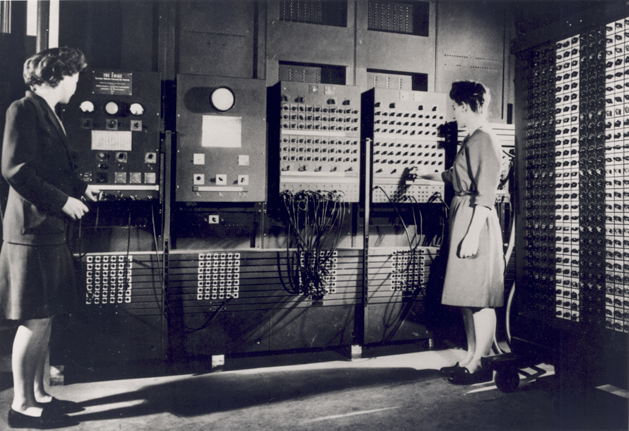
ENIACprogrammers Jean Bartik and Frances Spence prepare the computer forDemonstration Day in 1946. U.S. Army photograph, public domain.
The longer historical arc runs much deeper than cars, computers, and AI. Early calculating tools like the abacus showed that computation could be represented physically. Later mechanical calculators, punched-card systems, Babbage’s computing concepts, Lovelace’s programming insight, Hollerith tabulation, IBM enterprise computing, ENIAC, stored-program architecture, transistors, integrated circuits, mainframes, personal computers, the Web, search, cloud computing, smartphones, deep learning, transformers, ChatGPT, and multimodal AI all sit inside the same broad pattern: tools extend capability, then society reorganizes around the new capability.
How the Audience Reacted
The article’s argument can be tested against the public response. The following gauge codes 1,062 visible video comments by dominant reaction theme, then preserves the most-liked comment, the strongest overall insight, and five additional high-value reactions.
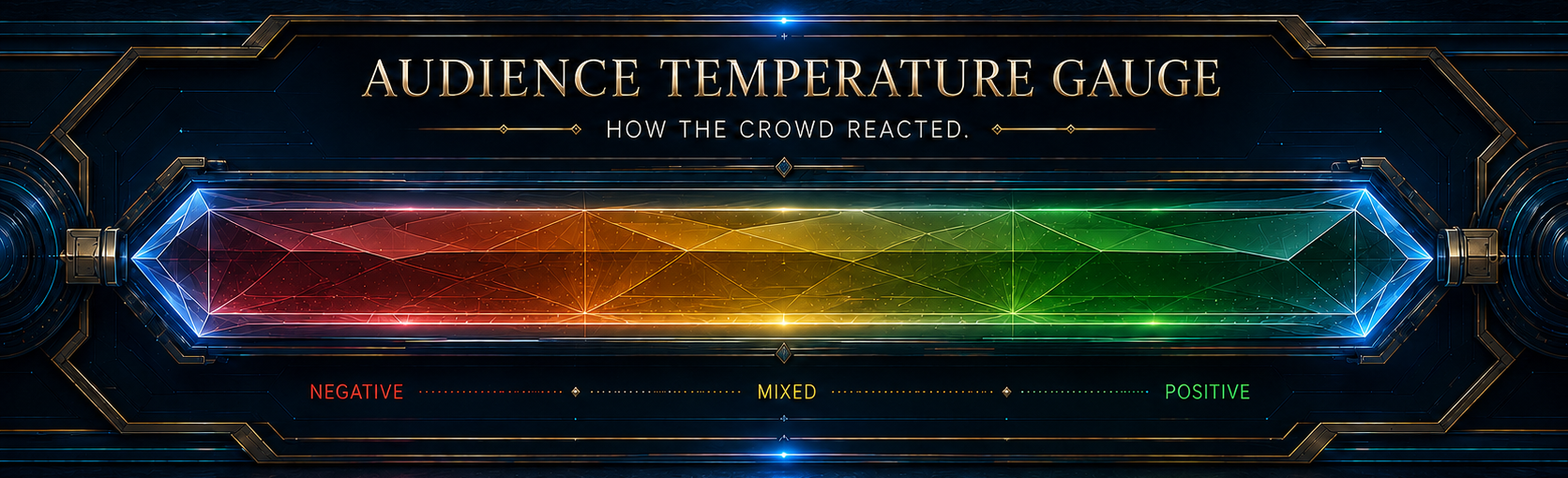
Audience Temperature Gauge
The comment section did not react as a single block. This gauge is based on visible public comments and groups them by dominant reaction theme. It is not scientific polling, but it is useful audience evidence for how the AI replacement-versus-enhancement conversation landed with viewers.
For this video, the public reaction leaned much darker than a simple jobs debate. The strongest pattern was existential anxiety about AI safety, loss of control, and human replaceability, followed by direct fear about economic survival and job displacement.
Audience Temperature Gauge
1,062 visible comments are coded by dominant reaction theme. The strongest signal was existential anxiety about AI safety, loss of control, and human replaceability, followed by fear about economic survival and job displacement.
These categories are editorial audience-reaction buckets, not scientific polling; they show how the replacement-versus-enhancement argument landed with viewers.
Breakdown of 1,062 coded public comments by dominant reaction theme.
1,062coded comments
01Existential / AI Safety Doom51.1%
02Job Loss / Economic Survival Fear28.1%
03Greed / Corporate Ethics Distrust5.2%
04Human Contact / Irreplaceable Care5.0%
05Podcast / Expert Reaction4.2%
06Return to Basics / Low-Tech Resilience2.9%
07Historical / Cultural Warning Analogy2.3%
08Humor / Meme / Side Reaction1.2%
Category Breakdown
Rank
Category
Count
Share
1
Existential / AI Safety Doom
543
51.1%
2
Job Loss / Economic Survival Fear
298
28.1%
3
Greed / Corporate Ethics Distrust
55
5.2%
4
Human Contact / Irreplaceable Care
53
5.0%
5
Podcast / Expert Reaction
45
4.2%
6
Return to Basics / Low-Tech Resilience
31
2.9%
7
Historical / Cultural Warning Analogy
24
2.3%
8
Humor / Meme / Side Reaction
13
1.2%
★Crowd Champion — Most-Liked Comment
@OldSusy-rc7dh — 31K likes
“The biggest problem, it seems to me, is human greed.”
Why it matters: It compressed the audience’s dominant distrust into one sentence. For many viewers, the problem was not AI capability by itself, but the human incentives guiding deployment.
✦Insight Laureate — Best Overall Comment
@taurus8263 — 8.4K likes
“For me, once AI takes over most of the jobs, the problem is not what I will do in my free time. I have plenty of hobbies and most probably I will not even have time for all of them. But I am worried about what I am going to eat, how I am going to pay for myself. Am I going to be starving and be completely controlled. These are real issues in my opinion.”
Why it matters: This comment turns the AI-replacement debate from abstraction into household reality. It names the fear underneath the conversation: food, money, autonomy, and stability.
Top 5 High-Value Comments
1. Best insider ethics signal — @prayerfuldailies
“I am in tech and I do not want to be in it anymore. The tone of direction is more of greed where ethics is side-stepped to please investors.”
Why it matters: This connects the backlash to implementation motive: the fear that AI is being driven by investor pressure before ethical discipline catches up.
2. Best economic feedback-loop argument — @michaelfriscia8166
“Companies use AI to do business more efficiently but then won't be able to do business because there will be no more customers able to afford their goods and services.”
Why it matters: If replacement destroys purchasing power, efficiency can undermine the customer base it depends on.
3. Best human-care boundary — @breatheeasy3829
“I work as a hospice nurse. I provide presence and connection for the dying and their loved ones. Trust me, people don't want to be comforted or guided through the death process by a robot with no emotions.”
Why it matters: This draws the clearest line between enhancement and replacement: some work is not merely task execution, but human presence.
4. Best cautionary principle — @SamanthaJRix
“Scientists were so preoccupied with whether they could, they didn’t stop to think if they should.”
Why it matters: Capability is not the same as wisdom. The familiar cultural reference captures the comment section’s ethical warning.
5. Best low-tech resilience signal — @thecowboypreacher6568
“I suggest people get back to the basics to acquire fundamental human skills to help them survive during the midst of any major transformations.”
Why it matters: People are not only afraid of AI; some are thinking about resilience, land, food, community, and durable skills.
Arena Read
The crowd reaction was not simply “AI will take jobs.” The dominant response was closer to existential unease: viewers heard the conversation as a warning about loss of control, human replaceability, and technology moving faster than ethics, governance, or ordinary people can absorb.
The strongest comments added a sharper business and social layer. People were not only afraid of the tool; they were afraid of the incentives behind the tool. The comment section repeatedly framed AI deployment as a question of greed, investor pressure, economic survival, and the protection of human contact in work that depends on presence, trust, and care.
That makes the comment layer highly relevant to the article’s core argument. The audience response supports the idea that AI is best understood right now as an enhancement tool inside a human operating system, not a clean replacement layer. The public temperature is not anti-technology as much as anti-replacement-without-judgment.
Comment Selection Disclaimer
Comments are selected for the value of the comment itself — clarity, insight, humor, public reaction, factual relevance, or contribution to the discussion. Selection does not endorse, investigate, validate, or judge the person who posted it. We are evaluating the comment, not certifying the commenter.





.png)
1. Best insider ethics signal — @prayerfuldailies
“I am in tech and I do not want to be in it anymore. The tone of direction is more of greed where ethics is side-stepped to please investors.”
Why it matters: This connects the backlash to implementation motive: the fear that AI is being driven by investor pressure before ethical discipline catches up.
2. Best economic feedback-loop argument — @michaelfriscia8166
“Companies use AI to do business more efficiently but then won't be able to do business because there will be no more customers able to afford their goods and services.”
Why it matters: If replacement destroys purchasing power, efficiency can undermine the customer base it depends on.
3. Best human-care boundary — @breatheeasy3829
“I work as a hospice nurse. I provide presence and connection for the dying and their loved ones. Trust me, people don't want to be comforted or guided through the death process by a robot with no emotions.”
Why it matters: This draws the clearest line between enhancement and replacement: some work is not merely task execution, but human presence.
4. Best cautionary principle — @SamanthaJRix
“Scientists were so preoccupied with whether they could, they didn’t stop to think if they should.”
Why it matters: Capability is not the same as wisdom. The familiar cultural reference captures the comment section’s ethical warning.
5. Best low-tech resilience signal — @thecowboypreacher6568
“I suggest people get back to the basics to acquire fundamental human skills to help them survive during the midst of any major transformations.”
Why it matters: People are not only afraid of AI; some are thinking about resilience, land, food, community, and durable skills.