SIMPLIFYPLUSAI | INSIGHTS AND ARTICLES

The Degree Bubble Already Burst

The article’s core diagnosis: the generic diploma was overprinted, debt-backed, and too often sold above its market value without a reliable return.

Article Overview

The generic college degree did not lose value because education stopped mattering. It lost value because the market overprinted the asset. Too many students were sold the old bargain — give the system four or five years, borrow heavily, get the diploma, and separate yourself from the pack — only to discover that the credential did not create the labor-market distance they thought they were buying.

That does not mean college is worthless or that education has no return. Many degrees remain essential job equipment or strong market signals: nursing, medicine, law, engineering, accounting, computer science, licensed professions, and practical programs with clear employment bridges. The problem is that the word degree now hides too much, covering everything from employer-legible training to vague, weak-signal credentials sold at strong-signal prices.

The business case is where the old promise starts to crack. Broad averages still show degree-holders earning more than non-degree workers, but those averages mask huge differences by major, school, cost, and job bridge. Students do not buy an average degree. They buy a specific credential at a specific price and take a specific debt risk, which means the real question is whether that exact purchase still delivers enough market separation to justify the bill.

That is why the evidence chain matters. Strada and the Burning Glass Institute found that 52% of four-year graduates were underemployed one year after graduation, and 45% were still underemployed ten years later. Public sentiment is moving in the same direction: online comments and video clusters repeatedly frame the experience as regret, not because learning is fake, but because many graduates feel the paper got them into another line instead of opening the door it was supposed to open.

The junk-wax baseball-card analogy captures the core collapse. Baseball cards did not fail because baseball became meaningless; they failed because ordinary ownership stopped being scarce while buyers still acted as though scarcity remained. The same thing happened to the generic diploma. The honest future is not anti-college. It is anti-snake-oil: require degrees where degrees are necessary, respect education where education is real, and stop selling weak-signal credentials under the old promise of debt, time, and dependable financial return.

Complete In-Depth Analysis

A young person does not need another sermon about the value of education. They need an honest label on the product being sold to them. That is where the modern degree market has lost the plot. The problem is not college. The problem is not learning. The problem is not serious liberal education, technical education, professional training, or intellectual development. The problem is the debt-backed credential machine that still sells many diplomas as if the old bargain were intact: give us four or five years, borrow the money, get the paper, separate yourself from the pack, and the better job will follow. For too many students, that bargain no longer works the way it was sold.

That is the real degree bubble. It is not anti-education. It is not an attack on nursing, medicine, law, engineering, accounting, computer science, skilled technical work, or serious programs with clear employment bridges. Those are not the same product. A nursing degree is job equipment. A medical degree is job equipment. An engineering degree with real training and internship experience is not the same labor-market signal as a vague, expensive credential that requires a paragraph before an employer can even understand what it means. The word “degree” now hides too much. It is like saying “professional athlete” and pretending an NBA star and a professional water polo player operate in the same economic universe. Technically, both may be professional athletes. Analytically, the label is almost useless.

The same is true of college degrees. A licensed nursing path, a law degree, an engineering degree, a debt-free accounting degree from a solid public university, a computer science degree with demonstrated projects, a general communications degree, and a self-designed interdisciplinary concentration are not one product. Treating them as one category is not analysis. It is a blender. The scandal is not that education has no value. The scandal is that the word “degree” now covers everything from required job equipment to expensive, weak-signal credentials, while the system still sells the whole category under the old promise of financial return.

Strip away the ceremony, the slogans, and the institutional romance, and the mass college bargain is financial. A young person gives the system four or five years and accepts tens of thousands of dollars in risk because they believe the credential will pay them back. If the degree did not produce a dollar more in future earnings, very few students outside wealthy enrichment circles or required professional paths would buy it. That does not make them anti-education. It makes them rational. The entire system depends on the belief that the diploma will create enough additional income to justify the time, debt, and delayed start. When that return weakens, the problem is not student cynicism. The problem is product failure.

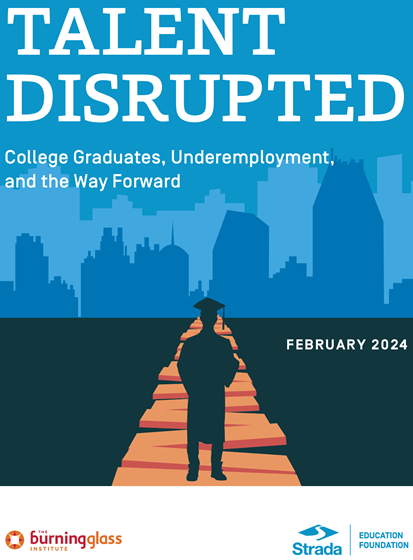
Talent Disrupted frames the central issue: college completion does not guarantee successful labor-market conversion. Source: Strada Institute for the Future of Work and Burning Glass Institute, 2024.

Return Is Not One Number

Median bachelor’s premium
Prime-age workers with a bachelor’s degree earn roughly 70% more at the median than workers with only a high school diploma.
Major matters
Georgetown research cited in the article shows median annual earnings ranging from about $58,000 in education/public service fields to about $98,000 in STEM.
Student question
The real decision is not “Does the average graduate earn more?” but “Does this specific degree, from this specific school, at this specific cost, justify the debt and time?”

That is why the old defense — “college graduates still earn more” — is true and still incomplete. Georgetown’s Center on Education and the Workforce reported that prime-age workers with a bachelor’s degree earn roughly 70% more at the median than workers with only a high school diploma. That matters. But the same research highlights that median annual earnings vary sharply by major, ranging from $58,000 in education and public service fields to $98,000 in STEM tracks. That $40,000 spread represents the real premium, or penalty, of the specific ticket a student buys. The broad average does not answer the question a real student has to answer. The real question is not whether the average degree holder earns more than the average non-degree holder. The real question is whether this specific degree, from this specific school, at this specific cost, for this specific student, creates enough market separation to justify the debt, lost time, delayed earnings, and opportunity risk.

For many students, that answer is no longer clear enough. For some, the answer is no. The public has already started saying this out loud, but not in the careful language of economists. Across YouTube, a whole cluster of videos has appeared around titles like “My College Degree is USELESS! People Regret Paying For School,” “This Is Why My College Degree is USELESS! People Regret Paying For School,” and “HELP! My College Degree is USELESS! People Regret Paying For School.” Search results and screenshots from this video cluster show individual videos drawing hundreds of thousands of views, thousands of comments, and tens of thousands of likes, all driven by the same vocabulary of regret, student debt, and credentials that refuse to convert into sustainable work.

A viral video is not a labor-market study. A comment section is not a scientific poll. But it is a temperature reading. People do not click those titles by the hundreds of thousands unless the words touch something they already feel, fear, or recognize. The data calls the problem underemployment. The internet calls it, “My college degree is useless.” The most important word in that sentence is not “useless.” It is “regret.” Regret means the buyer understood the product one way before purchase and another way after the bill came due. Regret means the person did what the system told them to do, walked across the stage, entered the labor market, and discovered that the credential did not create the separation they thought they were buying. Regret means the school got paid, the lender still wants payment, the employer still wants experience, and the graduate is left trying to explain why the paper did not open the door.

The After-the-Sale Receipt

Underemployment definition
A four-year graduate working in a job that typically does not require a bachelor’s degree.
One year after graduation
52% of graduates were underemployed.
Ten years later
45% were still underemployed.

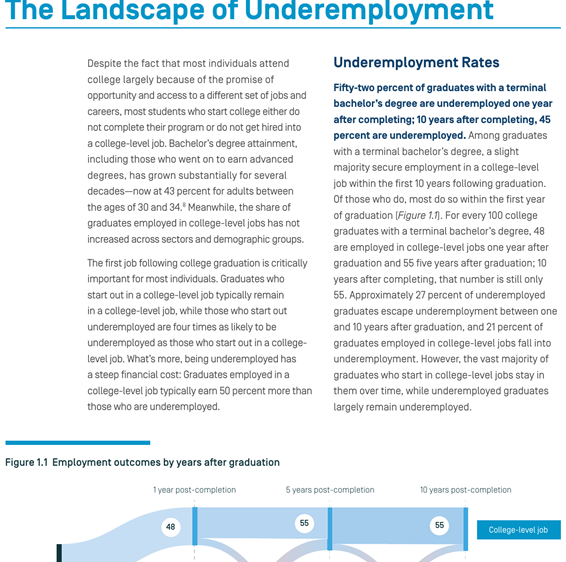
The underemployment data is where the old sales pitch starts to crack. Strada and the Burning Glass Institute’s Talent Disrupted study defines underemployment as a four-year graduate working in a job that typically does not require a bachelor’s degree. Their research found that 52% of graduates were underemployed one year after graduation, and 45% were still underemployed ten years later.

Employment pathways diverge sharply after graduation, with early underemployment creating long-term persistence. Source: Talent Disrupted, Figure 1.1.

That is not a footnote. That is the after-the-sale receipt. A student can do what the system told them to do, finish the degree, walk across the stage, and still end up in work that does not require the credential they borrowed money to get. The debt remains real even when the signal does not work. The payment does not care that the major had no clear employment bridge. The interest does not care that the brochure sounded inspiring. The loan balance does not care that the labor market was crowded. This is the buyer’s-remorse moment: four or five years later, tens of thousands of dollars exposed, and the graduate discovers the diploma did not put them ahead. It only got them into another line.

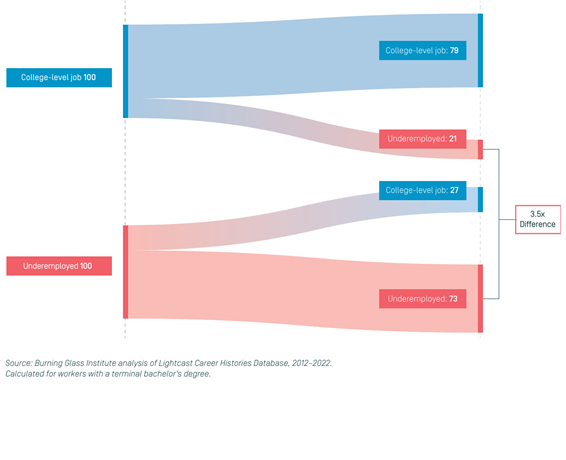
The report’s pathway comparison shows how initial job placement shapes whether graduates recover into college-level work or remain underemployed. Source: Talent Disrupted.

That is not the same thing as saying college is worthless. That is the opposite of the point. Some degrees still open doors because the work genuinely demands formal training. Some degrees are required because the law, the licensing body, or the profession says they are required. Some degrees build real competence. Some programs connect directly to internships, exams, clinical hours, portfolios, apprenticeships, technical skills, or hiring pipelines. A serious education that expands a student’s options is not the problem.

The problem is weak-signal credentials sold at strong-signal prices.

A credential can be meaningful inside the university and still be expensive to decode outside it. That is the danger with vague programs, hyper-customized concentrations, boutique interdisciplinary tracks, and expensive academic paths that may sound profound on campus but remain illegible in the labor market. The issue is not whether a student learned anything. The issue is whether the credential can be read, priced, and trusted by the market quickly enough to justify the cost. A traditional credential says something an employer can immediately understand: nursing, accounting, mechanical engineering, computer science, finance, chemistry, elementary education. A custom concentration may require a paragraph of explanation before the listener even knows what is being claimed. That does not make the student stupid. It means the signal is exceptionally expensive to decode.

And expensive-to-decode credentials become dangerous when they are sold with adult-sized debt attached. This is where the baseball-card analogy becomes useful. During the junk-wax era of the late 1980s and early 1990s, people bought new baseball cards as if they were buying future value. The logic seemed reasonable: old cards had become valuable, so new cards should become valuable too. But the market had changed. Manufacturers printed so many cards that ordinary scarcity disappeared. The object still looked like a collectible. The signal underneath it had changed. Junk-wax cards did not fail because baseball became meaningless. They failed because people confused owning a card with owning a scarce asset. The same mistake now sits inside the degree market. People confuse having a degree with having a rare labor-market signal.

For much of the 20th century, a college degree did real signaling work. It told employers that someone belonged to a relatively small, credentialed class. It suggested persistence, literacy, institutional approval, and a certain level of social sorting. But that signal diluted as the credential became common. The Census Bureau reported that roughly two in five U.S. adults age 25 and older now hold a bachelor’s degree or higher. A credential held by one in sixteen adults does not mean the same thing as a credential held by two in five. It can still have value. It can still represent work. But it no longer separates the way it once did. The ordinary degree has become less like a rare Mickey Mantle card and more like a mass-produced base card from a box set everyone bought.

Once ordinary ownership stops creating separation, value moves to the grading layer. In baseball cards, value migrated to condition, scarcity, rookie status, serial numbers, and independent grading verification. In the labor market, value moved to the grading layer: specific major, institutional selectivity, licensing, internships, technical portfolios, verified work history, and concrete evidence of actual capability. A generic degree with no market bridge is the ungraded base card. A licensed nursing degree is not. An engineering degree with internship experience is not. A debt-free accounting degree from a solid public university is not. A computer science degree with projects and demonstrated skill is not. But an expensive credential with no clear employer demand, no license, no hard skill signal, and no occupational bridge can absolutely behave like junk wax. Worse, it behaves like junk wax sold at vintage-card prices.

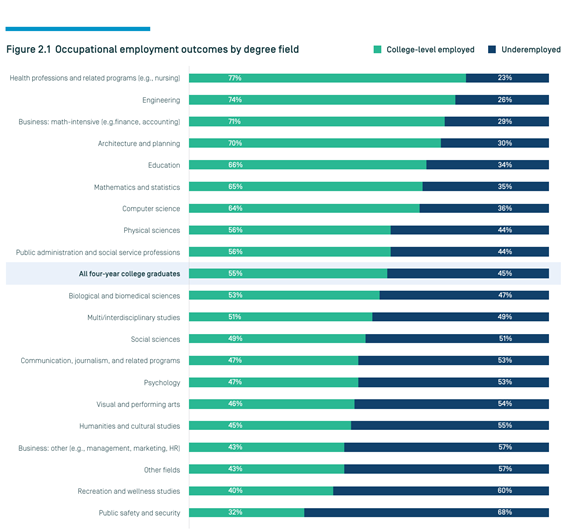
Underemploymentrisk varies substantially by field of study, reinforcing the article’s argumentthat “degree” is too broad to function as one honest market category. Source:Talent Disrupted, Figure 2.1.

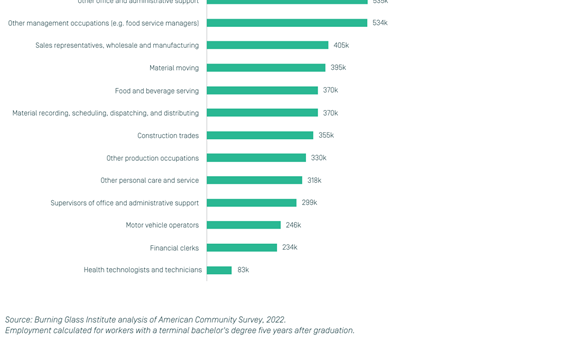
The university side is only half the story. Employers helped build the bubble too.

Underemploymentdiffers across occupational destinations, illustrating how the labor market—notthe diploma alone—determines whether a degree converts into college-level work.Source: Talent Disrupted, Figure 1.4.

For years, many companies used degrees as lazy screening devices for jobs that did not truly require degree-level academic preparation. Harvard Business School’s work on degree inflation found that more than six million jobs were at risk of degree inflation. In one stark historical example, 67% of production supervisor job postings asked for a college degree, while only 16% of people already successfully employed in that exact role actually held one.

That is not education. That is a toll booth.

If people are already doing the job without the credential, and employers suddenly require the credential for new applicants, the degree has stopped functioning as proof of necessary education. It has become an access fee. It tells young people and working adults: pay the system first, then maybe we will consider you. That gatekeeping creates a nasty loop. Employers require degrees for jobs that do not truly need them. Young people borrow money to get the degree because they are told they will be locked out without it. Then, once too many people have the degree, employers ask for experience, internships, elite schools, portfolios, certifications, and specialized proof on top of the diploma. The student buys the ticket, reaches the front of the line, and learns the ticket was only good enough to enter another line.

The supposed solution has been skills-based hiring. In theory, employers stop using degrees as blunt filters and focus on actual capability. That sounds promising. But corporate announcements are not the same thing as changed behavior. Many companies have changed job postings faster than they have changed actual hiring behavior. So the gate remains standing. Some companies just changed the wording on the sign. This is why the “college still pays” line can become dangerous when it is used carelessly. It is true enough to sound responsible and broad enough to hide the trap. The issue is not whether college can pay. The issue is whether institutions are honestly separating degrees that build market power from credentials that mostly sell hope.

That distinction matters even more because the price has been aggressively financed by debt. The education system did not simply become expensive because families suddenly had more cash sitting around. The student-loan infrastructure helped make higher prices possible. When buyers cannot pay out of pocket but can still borrow against their future earnings, schools face less immediate price resistance. The student does not need to have the money today; the student only needs to be financeable. The systemic consequence is clear: loans did not merely help students afford college. They helped colleges afford higher prices. That does not mean loans are the sole reason tuition rose. Real operational costs, reduced state support in certain periods, amenities competition, administrative growth, rankings pressure, facilities, and labor costs all matter. But the financing pipeline is the mechanism that allowed the mass market to keep functioning even as prices detached from what families could actually pay out of pocket.

A normal market eventually hits a wall. The buyer runs out of money. The lender says no. The product gets repriced. But higher education has operated under a different moral and financial shelter. The word “education” changes societal risk tolerance. A young person who could never borrow $100,000 for a car, a boat, or an untested business idea can take on life-shaping education debt because everyone around them repeats the same promise: this is an investment in your future.

That promise is the whole deal.

If the return is strong, the deal makes sense. If the degree creates real market power, opens a licensed profession, builds technical competence, or produces a clear employment bridge, then the time and money can be justified. But if the credential does not materially improve the student’s position, the same transaction starts to look very different. It stops looking like opportunity and starts looking like financial extraction with a graduation ceremony. That is why the trade comparison matters, even though it should not be romanticized. Electricians, plumbers, HVAC technicians, welders, linemen, mechanics, and other skilled workers do hard work. Trades are physically demanding. They carry long-term physical wear, apprenticeship barriers, regional variations, and income ceilings depending on region, specialization, union-scale work, overtime-heavy roles, contracting, and business ownership.

But many of those paths let a young person start earning sooner, build experience earlier, avoid large college debt, and become cash-positive while a college student is still paying premium prices just to prepare. The point is not that everyone should go into the trades. The point is that the old default advice — “just go to college” — became financially irresponsible the moment it ignored field, cost, debt, time, alternatives, and expected return. The old social contract said the diploma would separate the student from the pack. In too many cases, it now buys the student an expensive place in the same crowd.

That is the moral problem.

The students are not the main villains here. Some make poor choices. Some choose comfort over hard preparation. Some ignore obvious market signals. Personal responsibility still matters. But it is too easy to stop there because blaming the student lets the adults walk away clean.

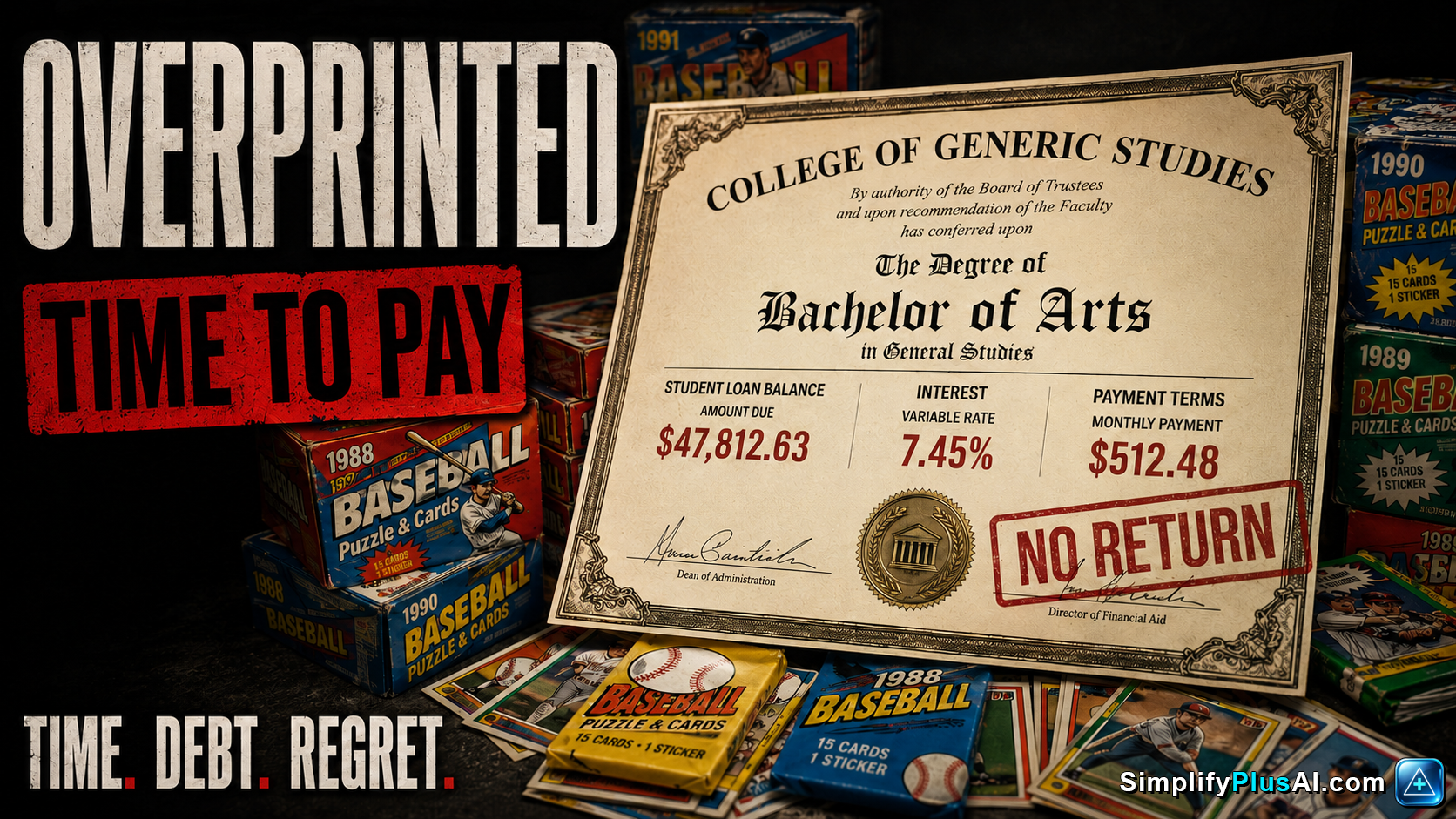
The adults built the machine.

Universities priced the credential. Employers inflated the requirement. Government lending made the money available. Parents and counselors repeated the old promise. Institutions collected payment upfront. The student carried the downside after the market delivered its verdict. Young people do not enter this market with equal information. The university knows the program. The employer knows the hiring market. The lender knows the repayment structure. The student often knows the least and carries the most permanent downside. That is not an equal transaction. That is a power imbalance wrapped in inspirational language. This is where the snake-oil comparison becomes fair. The old snake-oil salesman sold a bottle of confidence. The modern credential machine sells a framed promise. It does not always sell functional knowledge; it sells the belief that the credential will be understood, respected, and rewarded by the market.

A school can say it is not guaranteeing a job. Fine. But the entire college sales culture has leaned for decades on the implication that a degree is an investment in economic mobility. Parents heard it. Counselors repeated it. Employers reinforced it. Politicians subsidized it. Students believed it. When the credential does not produce the promised separation, the institution cannot simply shrug and say the student should have known better. That is why this subject cannot be reduced to “college is a scam.” College is not one product. Education is not one product. A degree is not one product. The whole category has fractured. Some degrees still open doors. Some degrees are required because the work genuinely demands formal training. Some degrees build intellectual and civic value that cannot be measured only by starting salary. Some degrees are worth it even when they do not lead directly to a narrow job title.

But some credentials are sold irresponsibly. Some are priced far beyond their market value. Some are used by employers as artificial gates. Some ask young people to borrow adult-sized debt for a signal the market treats as weak, vague, or ordinary.

The difference matters.

A real education should expand a young person’s options. A predatory credential narrows them while pretending it made them free. In the modern economy, the degree is no longer enough by itself. Students are being forced to master the grading layer — internships, hard technical skills, portfolios, licenses, networks, and specialized proof — while still being charged as if the base credential carries the old power. That is the degree bubble. It is not proof that education lost value. It is proof that the credential market lost honesty. The degree lesson is not that learning is fake. It is that mass credentialing, employer gatekeeping, and debt-backed sales destroyed the fantasy attached to the ordinary diploma.

The honest future is not anti-college. It is anti-snake-oil.

Require degrees where degrees are necessary. Respect education where education is real. Fund paths that produce skill, judgment, and mobility. Be honest about which programs lead to licensed work, which build technical competence, which require graduate school, which need portfolios, and which are mostly personal enrichment. Stop selling young people the old generic promise as if the market has not changed.

Because the market has changed—and the kids holding the debt already know it.

Audience Temperature Gauge

1,111 visible comments are coded by dominant reaction theme. The strongest pattern was buyer’s remorse around weak-signal degrees, debt, and the broken promise that any credential would reliably produce a return.

These categories are editorial audience-reaction buckets, not scientific polling. From 1,135 parsed comment blocks, 24 too-thin, off-topic, broken, unreadable, or low-signal fragments were excluded.

Audience Response Distribution

Breakdown of 1,111 coded public comments by dominant reaction theme.

01Weak-Signal Degree Mockery / Regret26.8%
02Degree Type / Job-Bridge Reality18.5%
03Trades / Lower-Debt Alternatives17.9%
04Debt / Tuition / Accountability16.7%
05Guidance / Financial-Literacy Failure9.5%
06Hiring Gate / Experience Trap8.1%
07Useful Degrees / Nuanced Pushback2.4%

Category Breakdown

RankCategoryCountShare
1Weak-Signal Degree Mockery / Regret29826.8%
2Degree Type / Job-Bridge Reality20618.5%
3Trades / Lower-Debt Alternatives19917.9%
4Debt / Tuition / Accountability18616.7%
5Guidance / Financial-Literacy Failure1059.5%
6Hiring Gate / Experience Trap908.1%
7Useful Degrees / Nuanced Pushback272.4%

Crowd Champion — Most-Liked Comment

@user-dm84 — 5.1K likes

“You majored in hobbies absolutely cracked me up.”

Why it matters: This comment won the crowd because it reduced the dominant audience judgment into one brutal phrase. The reaction was not just laughter at one person; it was a broader rejection of degree paths that look like personal interests being sold as career preparation.

Insight Laureate — Best Overall Comment

@SiliconValleyHighValue

“Majoring in hobbies is the perfect comment for the girl with the 4 degrees. If people want to major in these weird subjects and also insist on attending an expensive school, this is what you get. Does not mean college is a bad idea. There is a huge difference between majoring in finance or accounting at a state school with in-state tuition versus majoring in sociology at Cornell at an $80 to $100k price tag.”

Why it matters: This makes the article’s key distinction: the problem is not education as a category, but weak-signal degree choices, expensive schools, and poor return-on-investment planning being treated as if they are equivalent to practical, employer-legible paths.

Top 5 High-Value Comments

1. Best Moral Responsibility Point — @socketsproket

“The problem with laughing after the fact and aggressively saying, Didn’t you research this degree before you went to college? discounts the fact that literal children were the ones who had to decide on majors and send college applications as juniors and seniors in high school...”

Why it matters: This pushes back against pure mockery and adds moral weight. It argues that the system asks teenagers to make adult financial decisions before they fully understand debt, labor markets, or long-term consequences.

2. Best ROI / Social Contract Comment — @Thefullmath

“WE NEED to STOP telling young adults the only way to get ahead is to go to college. There are so many better affordable options. Doesn’t make sense to go into debt to get a paper that doesn’t guarantee you anything but debt...”

Why it matters: This is almost a compressed version of the article’s thesis: debt, weak guarantees, signal dilution, and the collapse of the old just-get-a-degree promise.

3. Best Alternative-Path Example — @wolfheart3085

“My son went to school for HVAC. It cost me less than $5,000 to pay for his certificates and he now makes over $120,000 a year. Let’s see AI fix your air conditioner!”

Why it matters: This gives the trade-path argument a concrete example: lower upfront cost, practical skill, faster earning power, and a market need that is not easily abstracted away.

4. Best Practical Degree-Recovery Comment — @lindsay-1324

“the one girl could use her spanish degree to be an interpreter for a hospital and make pretty good money...”

Why it matters: This adds needed nuance. Even a degree that looks weak in the abstract may become valuable when paired with a real employment bridge.

5. Best Institutional Accountability Comment — @paulstandaert5709

“I discovered this useless degree phenomenon about 22 years ago. The colleges seem to have no skin in the game when it comes to the whole loan forgiveness thing. They need to have a little accountability for selling a defective product.”

Why it matters: This captures the accountability gap: schools collect payment upfront, but the student carries the downside if the credential does not perform.

Arena Read

The crowd reaction was not simply anti-college. The dominant response was buyer’s remorse toward weak-signal degrees, especially degrees perceived as expensive, vague, poorly chosen, or disconnected from real work.

The mockery was loud, but the sharper pattern underneath it was category separation: commenters repeatedly distinguished practical, job-bridged education from credentials with no clear market bridge. That makes the comment layer unusually useful for the article. It does not replace labor-market evidence, but it gives the evidence a human temperature. The data calls it underemployment. The crowd calls it regret.

Comment Selection Disclaimer

Comments are selected for the value of the comment itself — clarity, insight, humor, public reaction, factual relevance, or contribution to the discussion. Selection does not endorse, investigate, validate, or judge the person who posted it. We do not research commenters’ personal histories, beliefs, affiliations, conduct, or online activity. A strong comment is treated as a strong comment, not as a character reference for the commenter. Working standard: We are evaluating the comment, not certifying the commenter.

Sources

  • Strada Institute for the Future of Work and Burning Glass Institute — Talent Disrupted (2024)
  • Burning Glass Institute analysis of the American Community Survey (2022)
  • Georgetown University Center on Education and the Workforce — bachelor’s-degree earnings research
  • Harvard Business School — degree-inflation research
  • U.S. Census Bureau — educational-attainment data

The supplied article names these sources but does not include verified URLs. Source names are preserved without invented links.

Corrections and Accuracy

If you notice a factual error or inaccuracy in this article, please notify us at contact@simplifyplusai.com. We will review the information and update the article where appropriate.

Back to Articles